Article
Strong El Niño forecast puts Panama's next dry season at risk
NOAA gives an 83% chance of the strongest El Niño since 1950 in October to December. During the 2023 El Niño, the canal cut transits to 22 a day.
What happened
The US Climate Prediction Center, part of the National Oceanic and Atmospheric Administration (NOAA), said on 8 October 2026 that El Niño continues to strengthen, "with a strong-to-very strong El Niño likely through January-March 2027", a chance it put above 83%, in its monthly ENSO discussion. An El Niño Advisory is in effect.
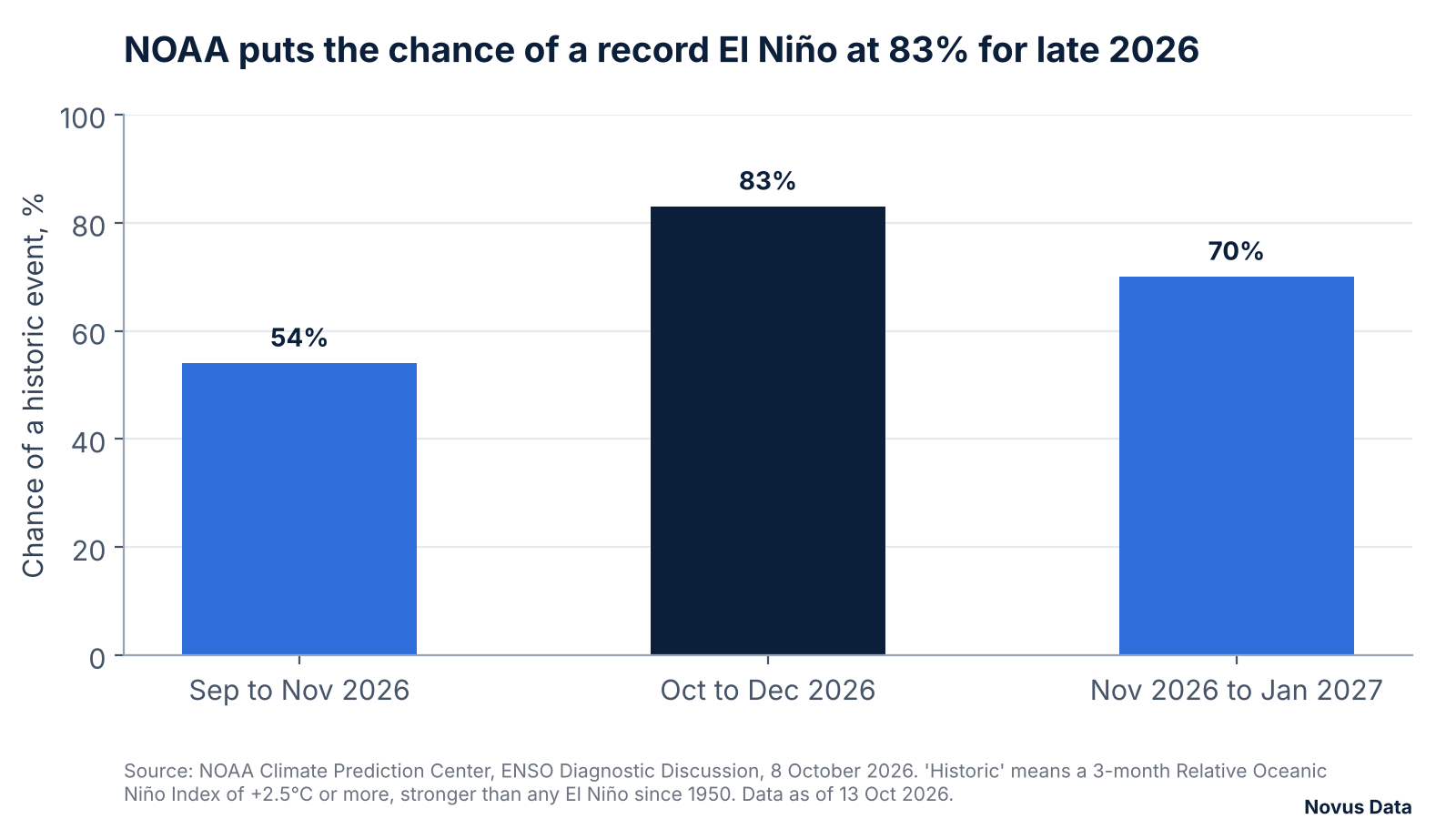
NOAA also put the chance of "a historic event that would exceed the strength of previous El Niño events dating back to 1950" at 54% for September to November, 83% for October to December and 70% for November to January. It defines such an event as a three-month value of +2.5°C or more on its Relative Oceanic Niño Index (RONI).
The warmth is concentrated in the eastern Pacific. Over the past month the Niño indices reached +2.1°C in the central Niño-3.4 region, +3.0°C in Niño-3 and +3.9°C in the Niño-1+2 region off Peru and Ecuador, according to the same discussion.
Why it matters
For trade, the most direct channel is the Panama Canal. Its locks depend on rain-fed Gatún Lake. When the watershed is dry, the Panama Canal Authority (ACP) cuts the number of daily transits, the depth ships may draw, or both. In 2023 the ACP attributed drought in the watershed to El Niño, called 2023 the second-driest year in its records and October 2023 the driest October on record. It limited transits to 22 a day before raising the limit to 24 from 16 January 2024, it said in a release on 15 December 2023.
The same pattern appeared on a smaller scale this year. On 20 August 2026 the ACP cited below-average rainfall linked to El Niño when it tightened booking rules and cut daily slots, according to advisories A-28-2026 and A-29-2026. In A-29-2026 it said rainfall since May was 34% below the historical average and flagged concern about water availability in the 2027 dry season, which runs from January to April. On 28 September it restored some capacity, citing September rainfall, in A-36-2026.
The lake enters the dry season with whatever the wet season leaves it. A strong El Niño that reduces rainfall in the remaining wet-season months would leave less water for January to April, when the lake is normally drawn down (inferred). NOAA notes that with an event of this size, the chances of typical El Niño impacts are larger, "though not guaranteed".
Who it reaches
Panama Canal users (sector). In both 2023 and August 2026 the ACP responded to low rainfall by cutting slots or tightening booking rules, so ships without bookings face longer waits or auction costs. Confidence: inferred from ACP notices of 15 December 2023 and 20 August 2026.
Container, LPG and LNG shipping (sectors). The ACP's current rules for the Neopanamax locks set weekly slot allocations for these segments (42, 21 and four respectively), with unfilled slots passed to other segments, which would shape who keeps access if capacity is cut again. Confidence: reported for the minimums, inferred for future cuts. Source: A-36-2026, 28 September 2026.
Users of the canal's water in Panama (sector). The ACP has described its task in droughts as balancing drinking water supply with the reliability of transits. Confidence: reported. Source: ACP, 6 August 2024.
What would change this view
- NOAA's 12 November update. A lower probability of a historic event would reduce the risk; a confirmed one would raise it.
- ACP advisories. Any cut to draft or slots before the end of the year would suggest the lake is heading into the dry season below normal.
- Rainfall in the watershed. El Niño's effects are tendencies, not certainties; a wet November and December in the watershed would weaken the link.
Sources
- ENSO Diagnostic Discussion. NOAA Climate Prediction Center, 8 October 2026. link
- Panama Canal to increase daily transits to 24 starting in January. Panama Canal Authority, 15 December 2023. link
- Advisory A-28-2026. Panama Canal Authority, 20 August 2026. link
- Advisory A-29-2026. Panama Canal Authority, 20 August 2026. link
- Advisory A-36-2026. Panama Canal Authority, 28 September 2026. link
- Panama Canal increases maximum allowable draft to 49 feet. Panama Canal Authority, 6 August 2024. link
Novus Data publishes analysis and commentary, not investment advice. Nothing here is a recommendation to buy or sell any security.
The Novus Data Briefing
Get the next briefing by email
Delivered by email. Free.