Article
178 China tariff exclusions expire on 9 November unless USTR acts
Goods covered by the exclusions face Section 301 duties if entered after 11:59 p.m. on 9 November 2026. No extension had been published by 13 October.
What happened
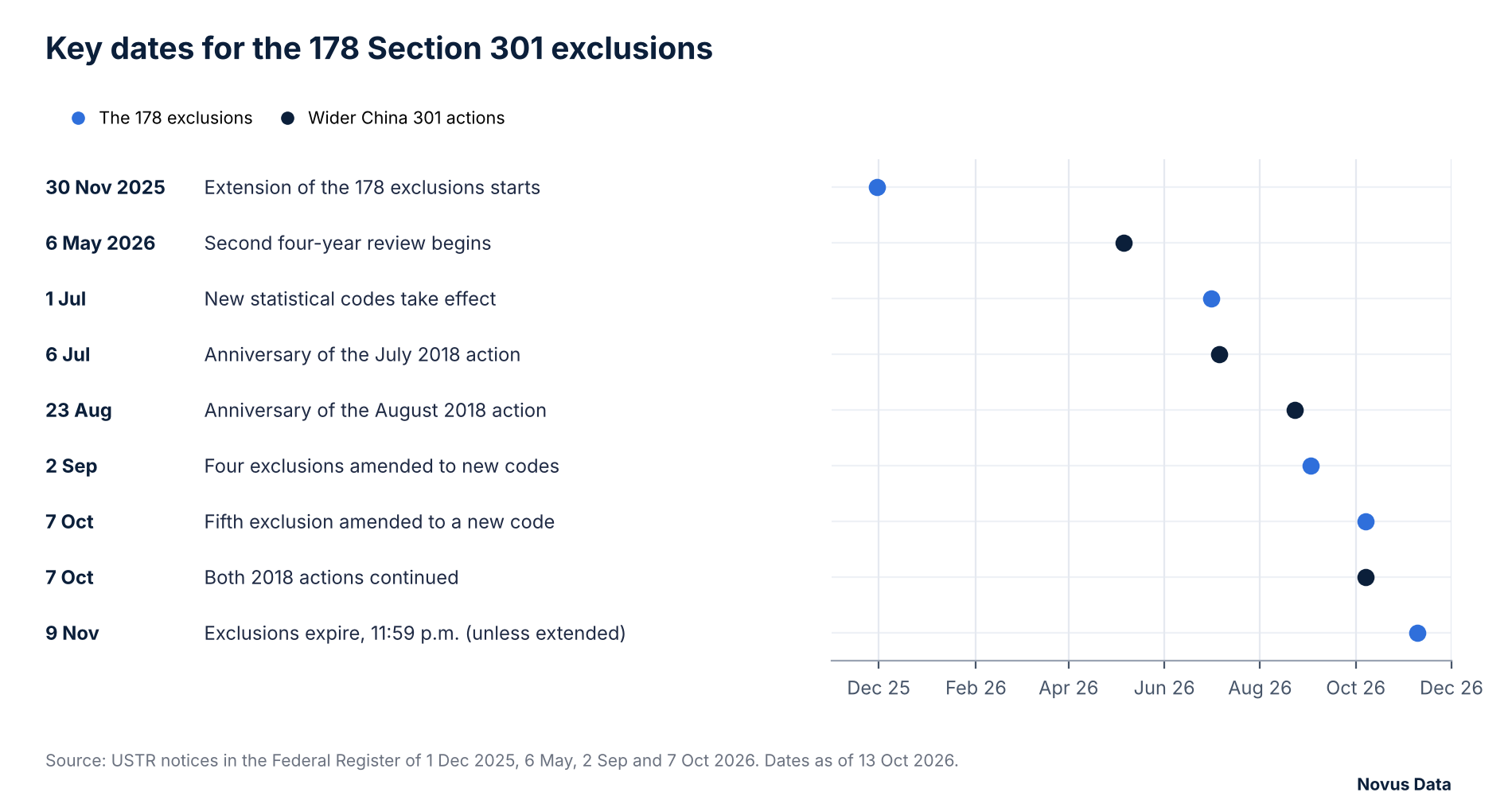
The Office of the US Trade Representative (USTR) extended 178 exclusions from the Section 301 tariffs on Chinese goods in a notice published in the Federal Register on 1 December 2025. The exclusions cover goods entered for consumption, or withdrawn from warehouse for consumption, from 12:01 a.m. EST on 30 November 2025 until 11:59 p.m. EDT on 9 November 2026, in the notice's words. Two sentences in the notice say the exclusions run "until November 10, 2026". The dates section and both annexes say 9 November, so this article uses that date.
The 178 come from two groups. In December 2023 USTR invited comments on whether to extend 352 previously reinstated exclusions and 77 related to Covid-19, and on 30 May 2024 it extended 164 of them through 31 May 2025. Separately, in connection with its four-year review, it announced fourteen exclusions for certain solar manufacturing equipment on 18 September 2024. Together they make 178, which were extended again, for 90 days at a time, through 29 November 2025 before the current notice.
Two notices since September changed the wording of some exclusions but not their dates. On 2 September 2026, USTR amended four exclusions to match changes the US International Trade Commission made to ten-digit statistical reporting categories, effective 1 July 2026. On 7 October it amended a fifth, adding a new statistical code, 8479.90.9591, for goods entered from 1 July. Also on 7 October, a separate notice confirmed that both 2018 China actions remain in effect after their four-year anniversaries, on 6 July and 23 August 2026. USTR said it would run a four-year review and publish a separate notice describing the process. That notice did not mention the exclusions. A search of USTR's Federal Register notices from 1 September to 13 October 2026 found no extension of the 178 exclusions.
Why it matters
An exclusion removes the Section 301 duty from a specific product. The notice covers goods "entered for consumption, or withdrawn from warehouse for consumption" before the cut-off, so the date that counts is the entry date, not the date the goods leave China. Goods entered after it would pay the duty for their tariff line (inferred).
That creates a deadline for physical cargo. Goods already in transit, or held in a bonded warehouse, are covered only if they clear before the cut-off. That gives importers of covered goods an incentive to time entries before 9 November (inferred). If many respond to it, the effect would show first in China-US container bookings in October.
The public comments leaned heavily towards extension. USTR said 147 of the 178 exclusions drew comments supporting extension, which argued that the products are available only in limited quantities outside China and that more time was needed to shift sourcing. Only ten of those also drew comments opposing extension, which generally argued that the products are available outside China, and some said the exclusions harmed a competing US industry. USTR linked its decision to the November 2025 US-China trade deal.
Who it reaches
Importers of solar manufacturing equipment (sector). Annex B of the notice extends the exclusions under heading 9903.88.70 and cites the September 2024 solar equipment notice, so it appears to hold the fourteen solar exclusions. Confidence: reported for the annex, inferred for the count. Source: USTR notice, 1 December 2025.
Importers of the other excluded products (sector). Annex A extends the exclusions under heading 9903.88.69. The notice says their scope is set by the ten-digit statistical numbers and product descriptions, so exposure varies by product. Confidence: reported for the list, estimated for any single importer. Source: USTR notice, 1 December 2025.
Importers of the five amended products (sector). Their exclusions now refer to new statistical codes for goods entered from 1 July 2026. USTR said the amendments maintain the existing product coverage, and that US Customs and Border Protection will issue entry guidance. Confidence: reported. Sources: USTR notices, 2 September and 7 October 2026.
What would change this view
- A new USTR notice. An extension published in the Federal Register before 9 November would reset the deadline. Watch the Federal Register for notices from USTR.
- The four-year review. USTR began the second statutory review on 6 May 2026, and requests to continue the actions were due by 5 July (for the July action) and 22 August (for the August action). USTR said it will publish a separate notice describing the review process and inviting comment.
- October bookings. A rise in China-US container bookings in October followed by a fall in November would confirm a pull-forward effect.
Sources
- Notice of Product Exclusion Extensions: China's Acts, Policies, and Practices Related to Technology Transfer, Intellectual Property, and Innovation. USTR, Federal Register, 1 December 2025. link
- Notice of Conforming Amendments to Product Exclusions. USTR, Federal Register, 2 September 2026. link
- Notice of Conforming Amendment to Product Exclusion. USTR, Federal Register, 7 October 2026. link
- Continuation of Actions: China's Acts, Policies, and Practices Related to Technology Transfer, Intellectual Property, and Innovation. USTR, Federal Register, 7 October 2026. link
- Initiation of Second Four-Year Review Process. USTR, Federal Register, 6 May 2026. link
Novus Data publishes analysis and commentary, not investment advice. Nothing here is a recommendation to buy or sell any security.
The Novus Data Briefing
Get the next briefing by email
Delivered by email. Free.