Article
Spot Brent tops $125 as Gulf barrels stay shut in
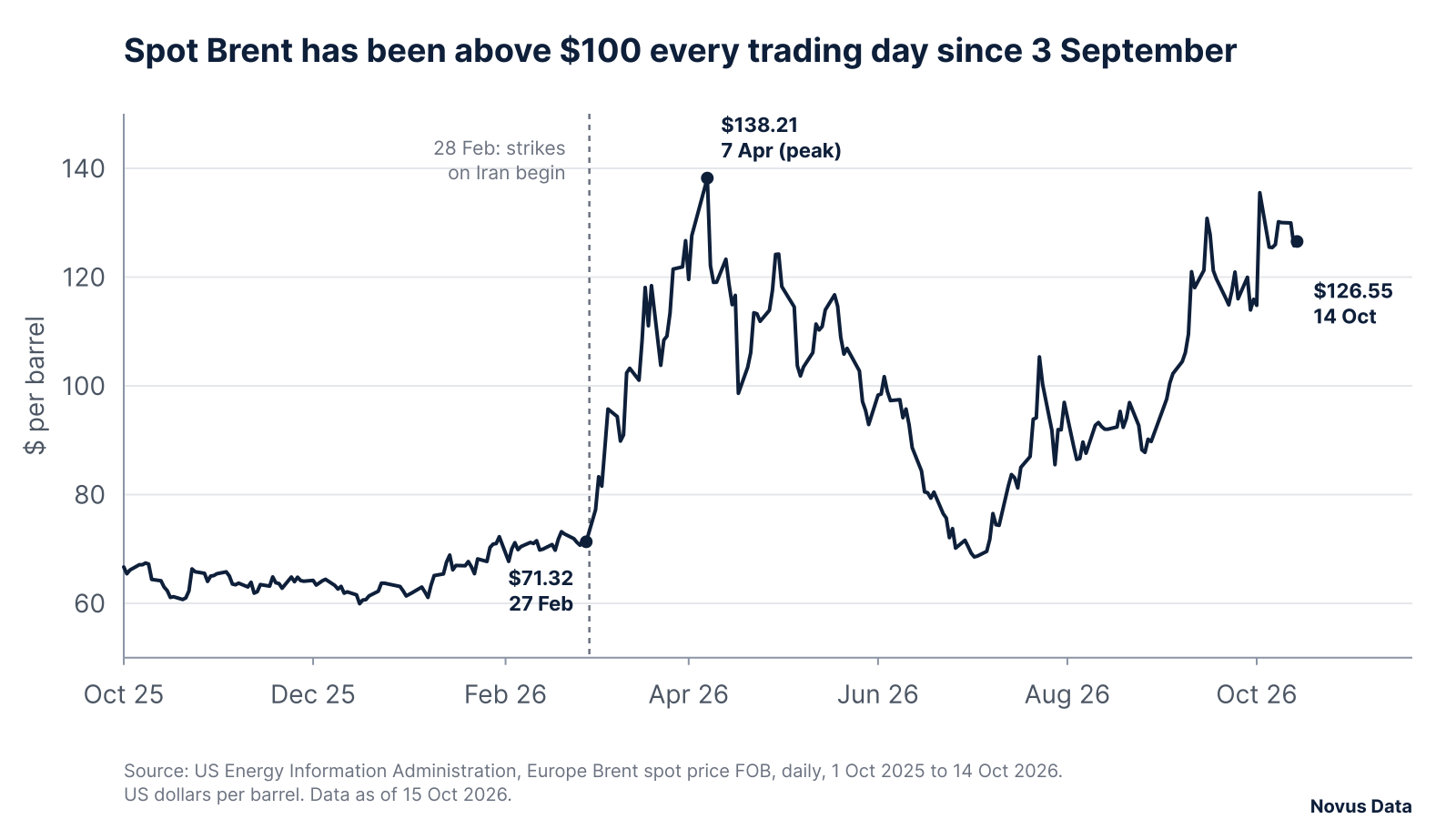
Spot Brent was 77% above its pre-war level on 14 October 2026. The EIA expects a $105 fourth-quarter average, but oil for prompt delivery trades far above futures.
What happened
The spot price of Brent crude was $126.55 a barrel on 14 October 2026, according to US Energy Information Administration data. That is 77% above the $71.32 recorded on 27 February, the last trading day before the United States and Israel launched strikes on Iran on 28 February. Spot Brent peaked at $138.21 on 7 April and reached $135.51 on 2 October.
In its Short-Term Energy Outlook of 6 October, the EIA said Brent averaged $114 in September and forecast a fourth-quarter average of $105, $14 higher than a month earlier. It expects $96 for 2026 as a whole and $84 in 2027, falling to $74 by the last quarter of 2027 as Gulf production recovers and stocks are rebuilt.
The agency estimates that crude production shut in by the Middle East disruption averaged 4.8 million barrels a day (b/d) in September, down from a peak of 10.9 million b/d in May, and assumes 4.5 million b/d stays offline in the fourth quarter. The International Energy Agency (IEA) gave a higher figure in its September Oil Market Report: more than 10 million b/d of Gulf production remained shut in, World Oil reported. The two estimates cover different dates and may use different definitions (inferred).
Why it matters
The gap between spot and futures prices suggests the shortage is in oil available for prompt delivery (inferred). On 1 October, Brent crude closed at $102.31 a barrel, a benchmark price set in the futures market, according to 24/7 Wall St, while spot Brent was $114.82, a gap of about $12.50. Buyers are paying a premium for oil they can load now over oil for later delivery, a pattern known as backwardation. Brent crude was $108.04 a barrel at 6:45 a.m. Eastern on 12 October, Fortune reported.
The premium reaches refiners first, then fuel buyers (inferred). The EIA said global inventories fell by 1.9 million b/d on average in the third quarter and expects a further 0.7 million b/d draw in the fourth. It also said tanker rates reached record levels in September, as insurance costs rose and longer routes tied up ships.
Bypass routes cover only part of the gap. Before it was attacked, Saudi Arabia's East-West pipeline carried more than 5 million b/d to the Red Sea port of Yanbu, according to the EIA. After repairs, it had partly resumed flows as of 22 September, the EIA said. Recorded tanker transits through the Strait of Hormuz averaged about one a day in September, against about 48 a day in 2025, according to IMF PortWatch daily chokepoint transit calls.
Who it reaches
Refiners that rely on Gulf crude (sector). Gulf oil exports in August were about 13 million b/d, nearly half of pre-war levels, according to the IEA's September report. Refiners that cannot replace those barrels pay the spot premium or cut runs. Confidence: reported for export volumes, inferred for refiners. Source: IEA via World Oil, 11 September 2026.
Airlines (sector). US Gulf Coast jet fuel was $4.56 a gallon on 14 October, against $2.43 on 27 February, according to EIA data. The August consumer price index showed airline fares up 23.4% on the year. Confidence: reported for prices, inferred for the link between them. Sources: EIA; BLS, 11 September 2026.
US crude producers (sector). The EIA expects US output to rise from 13.7 million b/d in 2025 to 13.9 million b/d in 2026 and 14.3 million b/d in 2027. Confidence: reported. Source: EIA, 6 October 2026.
What would change this view
- Talks on the strait. Iran's top negotiator said on 4 October that the strait would not reopen until seven Iranian conditions were met, Al Jazeera reported. An agreement would likely lower the spot premium quickly (inferred).
- The spot-futures gap. A narrowing gap would show physical supply easing before headline prices do (inferred).
- OPEC+. Seven OPEC+ members agreed on 4 October to keep November production at September levels, and meet again on 1 November, according to OPEC.
Sources
- Europe Brent spot price FOB, daily. US Energy Information Administration, data to 14 October 2026. link
- Short-Term Energy Outlook, global oil markets. EIA, 6 October 2026. link
- Short-Term Energy Outlook. EIA, 6 October 2026. link
- IEA cuts 2026 oil supply outlook as Gulf recovery slips to 2027. World Oil, 11 September 2026. link
- Brent oil is back above $100 as a third aircraft carrier heads to the Middle East. 24/7 Wall St, 2 October 2026. link
- Current price of oil as of October 12, 2026. Fortune, 12 October 2026. link
- US Gulf Coast kerosene-type jet fuel spot price, daily. EIA, data to 14 October 2026. link
- Consumer Price Index, August 2026. BLS, 11 September 2026. link
- Iran says Strait of Hormuz to remain closed until US meets conditions. Al Jazeera, 4 October 2026. link
- OPEC+ press release. OPEC, 4 October 2026. link
Novus Data publishes analysis and commentary, not investment advice. Nothing here is a recommendation to buy or sell any security.
The Novus Data Briefing
Get the next briefing by email
Delivered by email. Free.