Article
Hormuz looks empty on ship trackers, yet Gulf crude is moving
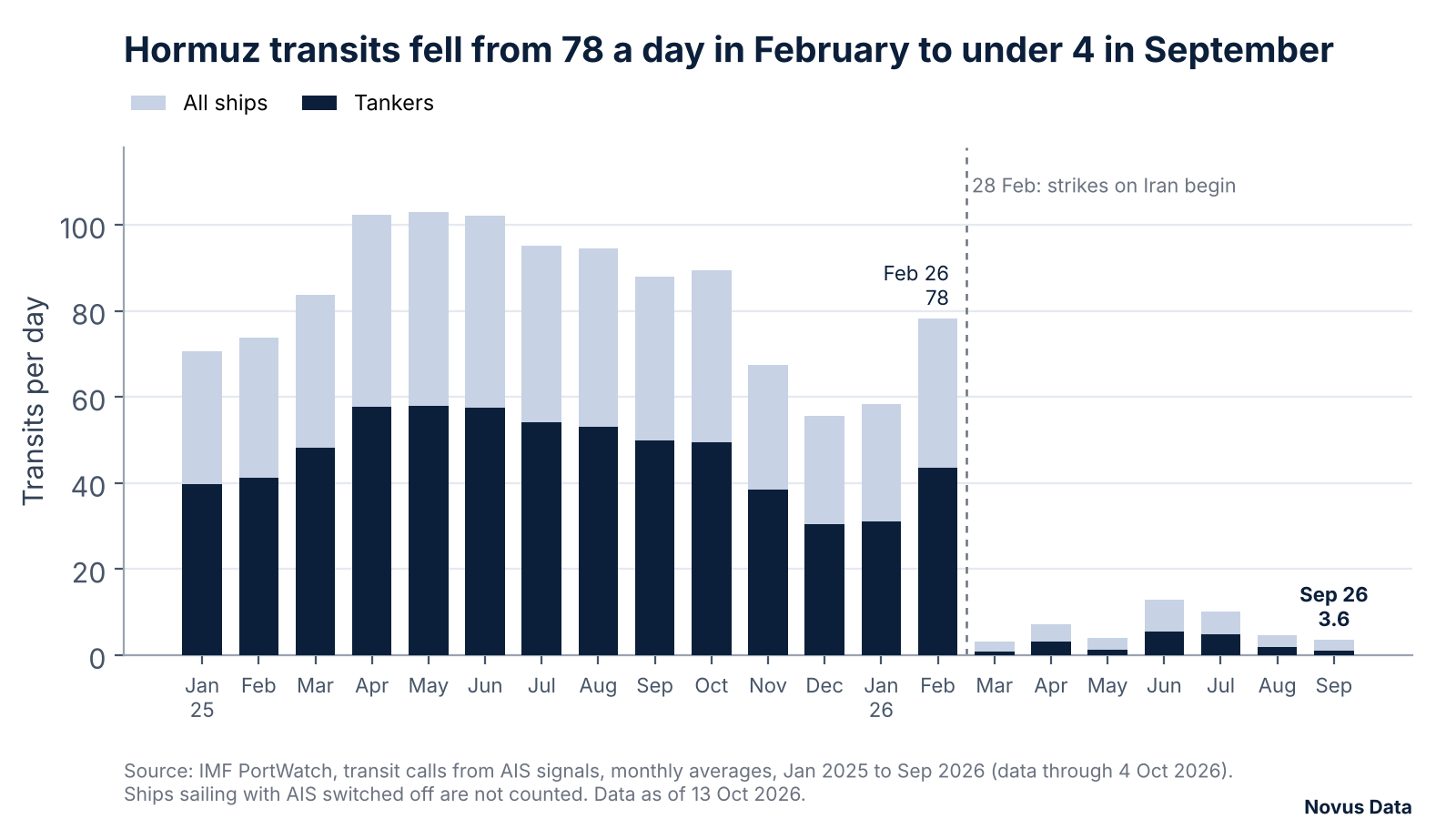
Public AIS data show under four transits a day through Hormuz in September 2026, against 86 a day in 2025. Cargo trackers say most Gulf crude still gets out.
What happened
Ships recorded passing through the Strait of Hormuz averaged 3.6 a day in September 2026, according to IMF PortWatch, which counts transits from vessels' automatic identification system (AIS) signals. In 2025 the average was 86 a day. Tanker transits averaged 1.1 a day in September. Recorded traffic collapsed after the United States and Israel launched strikes on Iran on 28 February, AFP reported, and has recovered only briefly since, to about 13 a day in June.
Other data point to more movement than that. The maritime analytics firm Windward counted 55 AIS-visible transits between 16 and 23 September and said the true number was "almost certainly higher", Maritime Executive reported on 30 September. The same report cited Kpler, a cargo tracker, as saying that crude volumes excluding Iran had returned to pre-war levels and reached at least 16.5 million barrels a day (b/d) in September. Kpler said more than 70% of crude crossing the strait in August changed tankers offshore. US Secretary of State Marco Rubio said the strait was open and that "there's almost as much oil flowing out now as there was before this conflict began", The National reported on 13 October.
Official energy agencies are less optimistic. The US Energy Information Administration estimated that crude production shut in by the Middle East disruption averaged 4.8 million b/d in September, down from 5.8 million b/d in August. The International Energy Agency said in September that more than 10 million b/d of Gulf supply remained offline, World Oil reported.
Why it matters
The figures differ because they count different things. AIS counts register only ships broadcasting their position, and Maritime Executive reported that most tankers in the strait sail with AIS switched off, and that two tankers struck on 29 September appeared to be transiting dark. AIS-based counts also differ in method: PortWatch recorded 27 transits over the eight days in which Windward counted 55 AIS-visible ones (inferred from PortWatch data). Kpler said more than 70% of crude crossing the strait in August changed tankers offshore, and a cargo moved this way can be counted as several short voyages, or not at all (inferred). Pipelines carry crude to ports beyond it altogether: Kpler estimated that about 40% of Gulf crude now leaves without crossing Hormuz, against 17% before the war.
The two measures answer different questions. Vessel counts show how much shipping capacity is tied up and how much risk carriers face. Barrel estimates show how much oil reaches the market. Kpler measures crude moved, while the EIA and IEA estimate production shut in, and the two agencies' own estimates differ by more than 5 million b/d (inferred).
The risk to ships has risen. At least 12 attacks on oil, LNG and LPG tankers took place between 28 September and 5 October, Reuters reported, citing maritime security sources, according to The National. The UK Maritime Trade Operations centre (UKMTO) reported six vessels struck in one day, five tankers and a container ship, the paper said. Iran's Islamic Revolutionary Guard Corps said it struck a supertanker transiting with its transponders off; that claim was not independently confirmed. The US Navy-led Joint Maritime Information Centre said the attacks showed Iran's "intent to assert [its] presence along key transit lanes". It had raised its threat level for the strait to "severe" on 7 July, Seatrade Maritime reported.
Who it reaches
ADNOC (company). Two tankers linked to Abu Dhabi National Oil Company were reported struck on 29 September: the Mersin Prosperity, which Equasis data list as ADNOC-managed, and the Al Ruwais, which Seatrade said appears to be ADNOC-owned and operated. Confidence: reported. Source: Seatrade Maritime, 30 September 2026, citing UKMTO, Vanguard Tech and Equasis data.
Kuwait Oil Tanker Company (company). The IMO's list of confirmed attacks includes a 28 September incident involving its tanker Al Funtas, with damage and no pollution. UKMTO said a vessel struck late that day caught fire, which was put out, and the crew were reported safe. Confidence: reported. Source: Seatrade Maritime, 30 September 2026.
Saudi crude exports via the Red Sea (sector). The East-West pipeline to Yanbu carried more than 5 million b/d before it was attacked, according to the EIA, and partly resumed flows on 22 September. Confidence: reported. Source: EIA Short-Term Energy Outlook, 6 October 2026.
Container shipping to Gulf ports (sector). A.P. Moller-Maersk said in August that inbound cargo to the Gulf had been rerouted to alternative ports while Hormuz traffic was disrupted. Confidence: reported. Source: Maersk, 13 August 2026.
What would change this view
- The JMIC threat level. A cut from "severe" would be the first official sign that insurers and carriers can return.
- PortWatch counts. A sustained rise in PortWatch-recorded transits from under four a day would be the clearest sign that ships are again sailing openly.
- Talks. Iran's top negotiator, parliament speaker Mohammad Bagher Ghalibaf, said on 4 October that the strait would not open until seven Iranian conditions based on the Islamabad memorandum were met, Al Jazeera reported. Any agreement would show first in daily transit data.
Sources
- Daily chokepoint transit calls, Strait of Hormuz. IMF PortWatch, data through 4 October 2026. link
- Three vessels struck in Strait of Hormuz as Iran's grip loosens. Maritime Executive, 30 September 2026. link
- Strait of Hormuz attacks surge as Iran steps up campaign against US-backed oil shipping. The National, 13 October 2026. link
- Four vessels struck in Hormuz in 24 hours. Seatrade Maritime, 30 September 2026. link
- JMIC raises Strait of Hormuz threat level to severe. Seatrade Maritime, 7 July 2026. link
- Short-Term Energy Outlook, global oil markets. EIA, 6 October 2026. link
- IEA cuts 2026 oil supply outlook as Gulf recovery slips to 2027. World Oil, 11 September 2026. link
- Maersk delivers strong Q2 and raises full-year guidance. A.P. Moller-Maersk, 13 August 2026. link
- Iran says Strait of Hormuz to remain closed until US meets conditions. Al Jazeera, 4 October 2026. link
- US strikes Iran (AFP caption, 28 February 2026 start of operations). The Standard. link
Novus Data publishes analysis and commentary, not investment advice. Nothing here is a recommendation to buy or sell any security.
The Novus Data Briefing
Get the next briefing by email
Delivered by email. Free.