Article
US-China trade truce extended two months, to 10 January 2027
The September summit kept last year's suspensions and produced recommendations for tariff cuts on $30 billion of goods each way, but left rare earths and chips unresolved.
What happened
President Donald Trump and President Xi Jinping met in Washington from 23 to 25 September 2026, according to CSIS. Treasury Secretary Scott Bessent said on 23 September that the conditions of the trade truce agreed in Busan, South Korea, in October 2025 would stay in effect until 10 January 2027, two months beyond the original November expiry, Supply Chain Dive reported. It added that the White House had yet to document the extension. No Federal Register notice formalising it had been published by 13 October.
The Busan arrangement, which took effect on 10 November 2025, suspended several measures for a year, according to a summary by China Briefing. China's commerce ministry (MOFCOM) suspended the rare earth export controls it announced on 9 October 2025, though controls announced on 4 April 2025 stayed in force. China also suspended its ban on exports to the US of dual-use items related to gallium, germanium and antimony until 27 November 2026. The US suspended a rule extending export restrictions to companies at least 50% owned by listed entities, and both sides suspended port fees on each other's ships.
At the summit, the White House announced recommendations for reciprocal tariff reductions on $30 billion of non-sensitive goods in each direction, and China committed to import at least 10 million tonnes of US coal a year in 2027 and 2028, according to the German Marshall Fund (GMF). MOFCOM said the two sides would set up a China-US trade council, with an agriculture working group meeting before the end of 2026, investingLive reported on 28 September.
Why it matters
The extension sets the cost of trade with China into January, not beyond. Importers placing orders for 2027 face the possibility that suspended measures return on 10 January if talks fail (inferred). Two summits fall before that date: the Asia-Pacific Economic Cooperation leaders' meeting in Shenzhen on 18 and 19 November, according to the Shenzhen government, and the G20 leaders' summit in Doral, Florida, on 14 and 15 December, according to the State Department.
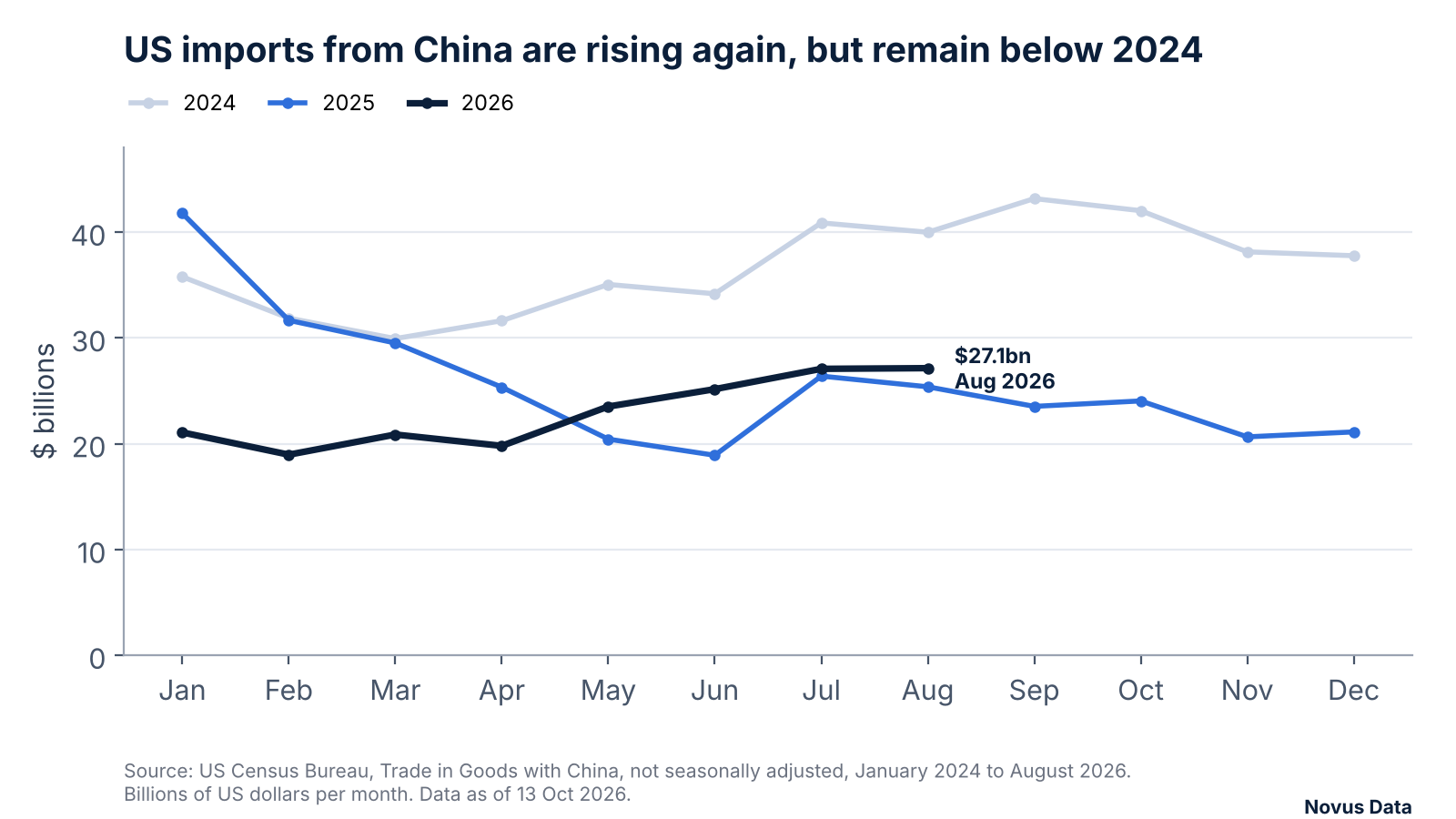
Trade has already shrunk. US goods imports from China were $183.5 billion in the first eight months of 2026, against $219.3 billion a year earlier and $279.2 billion in 2024, according to the US Census Bureau. Monthly imports have risen since the spring, from $19.8 billion in April to $27.1 billion in August.
Assessments of the summit differ. A CSIS analysis listed rare earths, semiconductor export controls and the durability of the truce among unresolved issues. GMF called the results mixed. A writer for The Daily Signal, from the Heritage Foundation's Asian Studies Center, argued that the administration protected US interests without conceding on key issues. The Center for American Progress argued that it gave up long-term bargaining power for temporary truces.
Who it reaches
Manufacturers using Chinese rare earths (sector). Exports of items covered by China's April 2025 controls still need licences. GMF cited a Financial Times report that Beijing was meeting only two-thirds of its commitments on rare earths and other critical minerals. Confidence: reported. Sources: China Briefing; GMF, 28 September 2026.
US coal producers (sector). China committed to import at least 10 million tonnes of US coal a year in 2027 and 2028, according to GMF; China's commerce ministry called US coal imports "a beneficial complement to China's domestic coal market". Confidence: reported. Sources: GMF; investingLive.
Ocean carriers serving US-China trade (sector). The US suspension of port fees on Chinese-linked ships runs until 9 November under its Federal Register notice. Unless the extension is formalised, fees could apply from 10 November. Confidence: reported for the date, inferred for the risk. Source: USTR via Federal Register.
What would change this view
- A written extension. A USTR or White House document extending the suspensions to 10 January would remove the 9 to 10 November risk for importers and carriers.
- Rare earth licences. Faster approvals under the April 2025 controls would ease the main supply risk; slower approvals would sharpen it.
- 27 November. Whether China extends its suspension of the gallium, germanium and antimony export ban.
Sources
- US, China to extend trade war truce by 2 months. Supply Chain Dive, September 2026. link
- Trump-Xi meeting: outcomes and implications. China Briefing, November 2025. link
- A Trump-Xi summit scorecard. German Marshall Fund, 28 September 2026. link
- China and U.S. to set up trade council and extend trade truce to January 2027. investingLive, 28 September 2026. link
- Trade in goods with China. US Census Bureau, data through August 2026. link
- Takeaways from the Trump-Xi White House summit. CSIS, 28 September 2026. link
- The Trump-Xi summit preserves US strength and leverage. The Daily Signal, 1 October 2026. link
- Trump-Xi summit scorecard. Center for American Progress, 1 October 2026. link
- Notice of modification of Section 301 action: China's maritime, logistics and shipbuilding sectors. USTR, Federal Register, 13 November 2025. link
Novus Data publishes analysis and commentary, not investment advice. Nothing here is a recommendation to buy or sell any security.
The Novus Data Briefing
Get the next briefing by email
Delivered by email. Free.