Article
US hiring slows to 29,000 as fuel-driven inflation outpaces pay
Payrolls rose by 29,000 in September 2026. In August, average hourly pay was 3.1% higher than a year earlier while consumer prices were 3.4% higher.
What happened
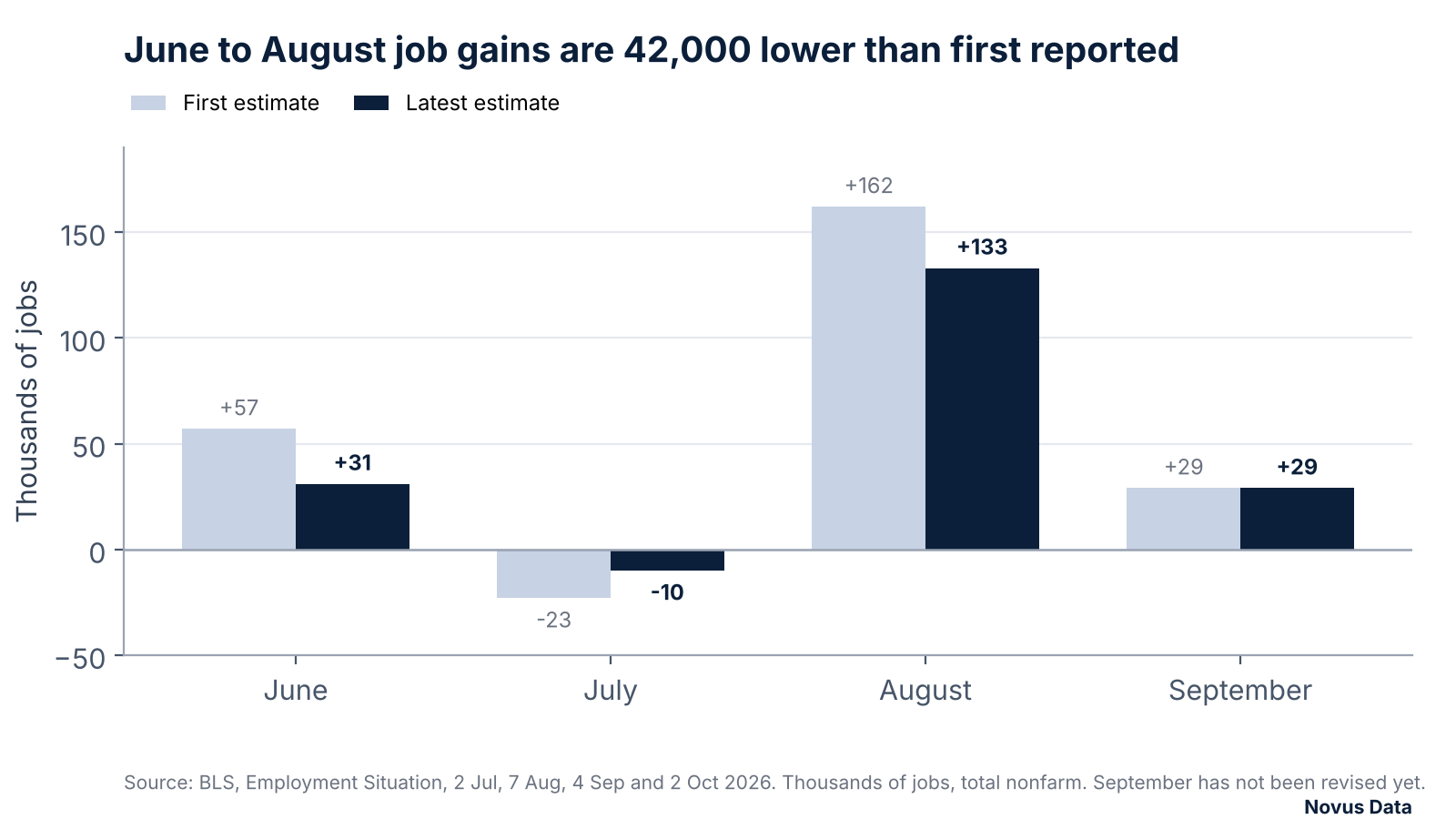
US employers added 29,000 jobs in September 2026, the Bureau of Labor Statistics (BLS) said in its Employment Situation report on 2 October. The report revised July to a loss of 10,000 jobs, from a gain of 21,000 in the previous estimate, and August to a gain of 133,000, from 162,000. Over the three months to September, payrolls rose by an average of 51,000 a month. The unemployment rate was 4.2%, within the range of 4.1% to 4.3% it has held since March, and the labour force participation rate was 61.8%, little changed since January.
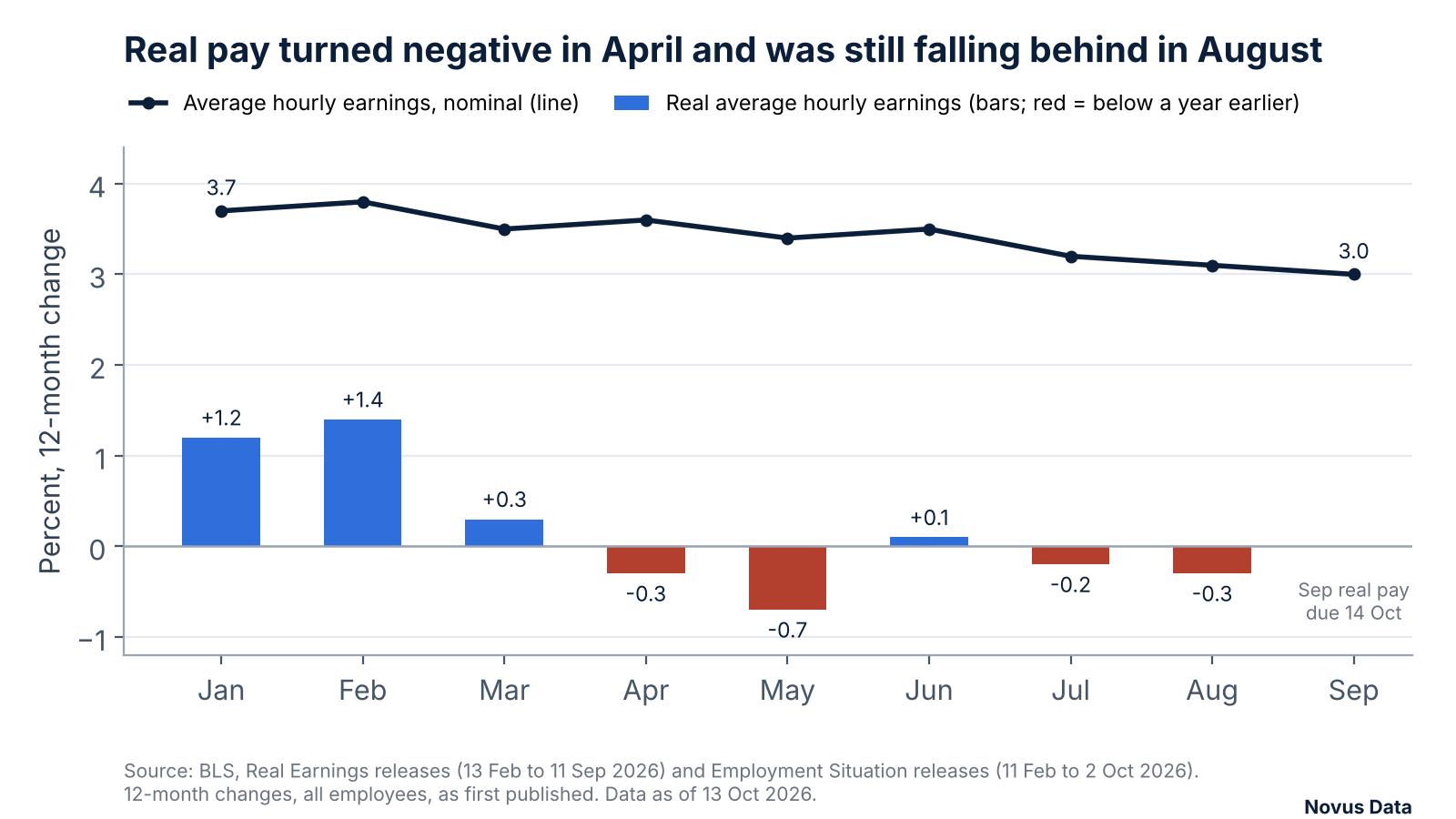
Inflation is running above pay growth. The consumer price index rose 3.4% in the 12 months to August, the BLS said in its August CPI report, with energy prices up 16.3%, gasoline up 27.4% and airline fares up 23.4%. Excluding food and energy, prices rose 2.4%, slightly less than the 2.5% of July. Average hourly earnings rose 3.1% in the year to August and 3.0% in the year to September. The September CPI report, published on 14 October, showed prices 3.7% higher than a year earlier, with energy up 20.4%, gasoline up 34.2% and airline fares up 22.4%; excluding food and energy, prices rose 2.6%.
In its real earnings release for August, the BLS said real average hourly earnings, which adjust pay for CPI inflation, were 0.3% lower than in August 2025. As first published, real pay was 1.4% higher than a year earlier in February, the month the US and Israeli strikes on Iran began (on 28 February), and 0.3% higher in March. It was below its year-earlier level in April (down 0.3%), May (down 0.7%), July (down 0.2%) and August (down 0.3%), and 0.1% above it in June. In September it was 0.7% lower than a year earlier, according to the real earnings release of 14 October.
Why it matters
The pattern fits an energy shock rather than an overheating economy (inferred). Prices tied to fuel have risen sharply, while core inflation, which excludes food and energy, eased to 2.4% in August from 2.5% in July before rising to 2.6% in September. Higher fuel bills act like a tax on households, leaving less to spend on other goods (inferred). If the squeeze continues, it would reach imported consumer goods, and through them the container lines and ports that serve US importers (inferred).
It also bears on the Federal Reserve's position. The Fed raised rates on 16 September, and Fed Chairman Kevin Warsh said its aim was to stop changes in relative prices, such as oil, broadening into second- and third-order effects in the economy, according to the press conference transcript. Annual wage growth has slowed rather than accelerated, from 3.7% in the January report to 3.0% in September, as first published. The wage data show no sign yet of the energy shock feeding back into pay (inferred).
The revisions matter too. The 2 October report cut its previous estimates for July and August by a combined 60,000 jobs. Against the first estimates, job gains for June to August are now 42,000 lower: 154,000 in total, against 196,000 first reported.
Who it reaches
Transport and warehousing workers (sector). Employment in transportation and warehousing was little changed in September, with a gain of about 7,600 jobs. Confidence: reported. Source: BLS, 2 October 2026.
Manufacturing (sector). Factory employment was little changed in September (+9,000) but is up 72,000 since a low in December 2025, the BLS said, with plastics and rubber products and machinery each adding 5,000 jobs in September. Confidence: reported. Source: BLS, 2 October 2026.
Airlines and travellers (sector). Airline fares in the CPI rose 23.4% in the year to August and 22.4% in the year to September. Confidence: reported for fares, inferred for the link to fuel costs. Source: BLS, 11 September and 14 October 2026.
What would change this view
- Core inflation. A rise above 2.4% would suggest energy costs are spreading into other prices. The September reading, published on 14 October, was 2.6%.
- The October jobs report, due on 6 November. Another month of near-zero payroll growth, or an unemployment rate above 4.3%, would point to a weakening labour market.
- Revisions. The 2 October report lowered July and August by a combined 60,000 jobs. Further downward revisions would weaken the picture of the summer.
Sources
- The Employment Situation, September 2026. BLS, 2 October 2026. link
- The Employment Situation, January to August 2026 releases. BLS, 11 February to 4 September 2026, for the 12-month earnings changes as first published. link
- Consumer Price Index, August 2026. BLS, 11 September 2026. link
- Consumer Price Index, September 2026. BLS, 14 October 2026. link
- Real Earnings, September 2026. BLS, 14 October 2026. link
- Real Earnings, August 2026. BLS, 11 September 2026. link
- Real Earnings, January to July 2026 releases. BLS, 13 February to 12 August 2026. link
- Transcript of Chairman Warsh's press conference. Federal Reserve, 16 September 2026. link
- Employment Situation release schedule, October 2026 reference month: 6 November 2026. BLS. link
- Letter to the Speaker of the House on military action taken on 28 February 2026 against Iran. The White House, 2 March 2026 (House Document 119-139). link
- Israel and US launch strikes on Iran. Daily Maverick, 28 February 2026. link
Correction, 15 October 2026: an earlier version of this update said real average hourly earnings in September were 0.8% lower than a year earlier. The BLS figure is 0.7%. The earlier number was calculated with the wrong price index (CPI-W, which BLS uses only for production and nonsupervisory employees) rather than taken from the release.
Novus Data publishes analysis and commentary, not investment advice. Nothing here is a recommendation to buy or sell any security.
The Novus Data Briefing
Get the next briefing by email
Delivered by email. Free.