Article
Fed lifts rates for the first time since 2023
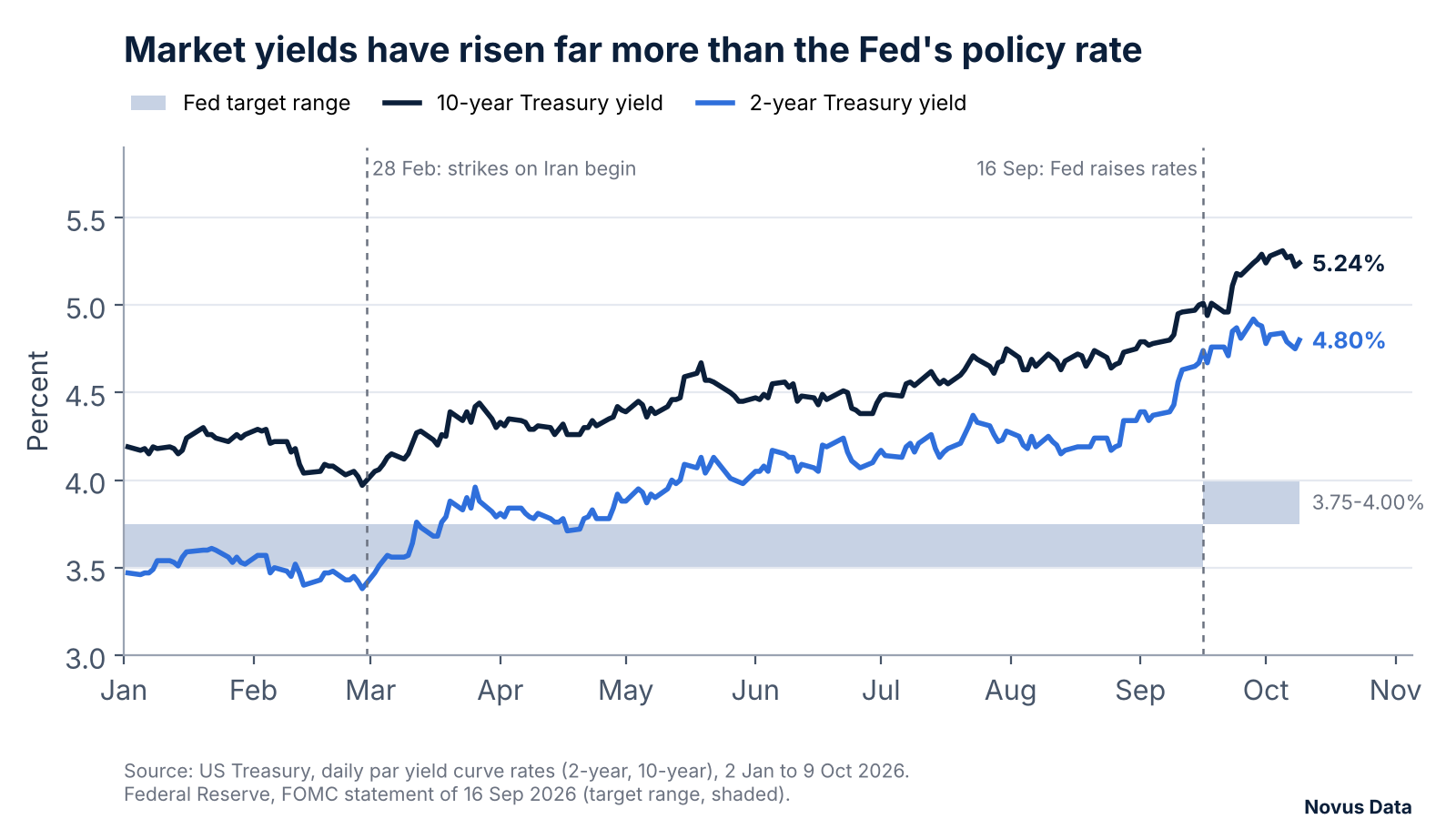
The Fed raised rates on 16 September 2026, and minutes released on 7 October show most officials expect another rise by year end.
What happened
The Federal Open Market Committee raised the federal funds target range by a quarter of a percentage point, to 3.75% to 4.00%, on 16 September 2026, by a vote of 12 to 0, according to its statement. It was the first increase since July 2023, according to the Fed's record of rate decisions. The Fed cut rates three times in late 2025, to 3.50% to 3.75%, and held them there until September.
The statement said inflation "remains elevated" and that uncertainty remained elevated owing, in part, to geopolitical developments. It did not mention energy or the Middle East by name. At his press conference, Fed Chairman Kevin Warsh said "We cannot affect any individual price, whether it be oil prices", and that the Fed would ensure that changes in relative prices do not "broaden out" into second- and third-order effects in the economy.
The minutes, published on 7 October, said most participants judged that another increase "would likely be appropriate by year end", and that participants generally assessed inflation risk as skewed to the upside. In the Summary of Economic Projections, the median official expected personal consumption expenditures (PCE) inflation of 3.7% in 2026, measured fourth quarter on fourth quarter, and a year-end policy rate of 4.1%, the midpoint of the range. That implies one more quarter-point increase this year (inferred).
Why it matters
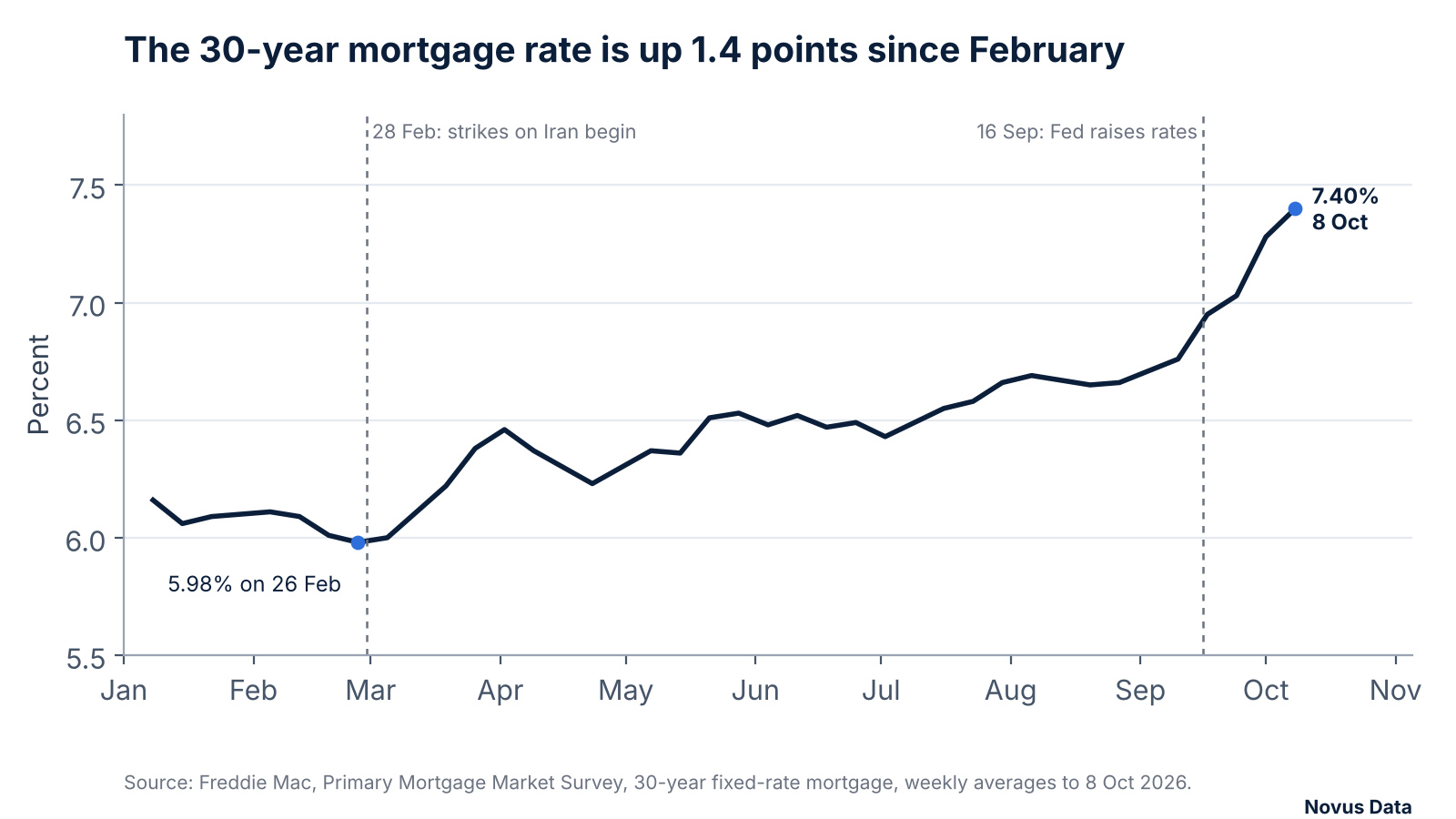
Market borrowing costs have risen much more than the policy rate. The 10-year Treasury yield was 5.24% on 9 October 2026, against 3.97% on 27 February, according to US Treasury data. That February date was the last trading day before the US and Israeli strikes on Iran, which began on 28 February, according to the President's 2 March letter to Congress and Daily Maverick. The 2-year yield rose from 3.38% to 4.80% over the same dates. The average 30-year fixed mortgage rate was 7.40% on 8 October, against 5.98% on 26 February, according to Freddie Mac's weekly survey.
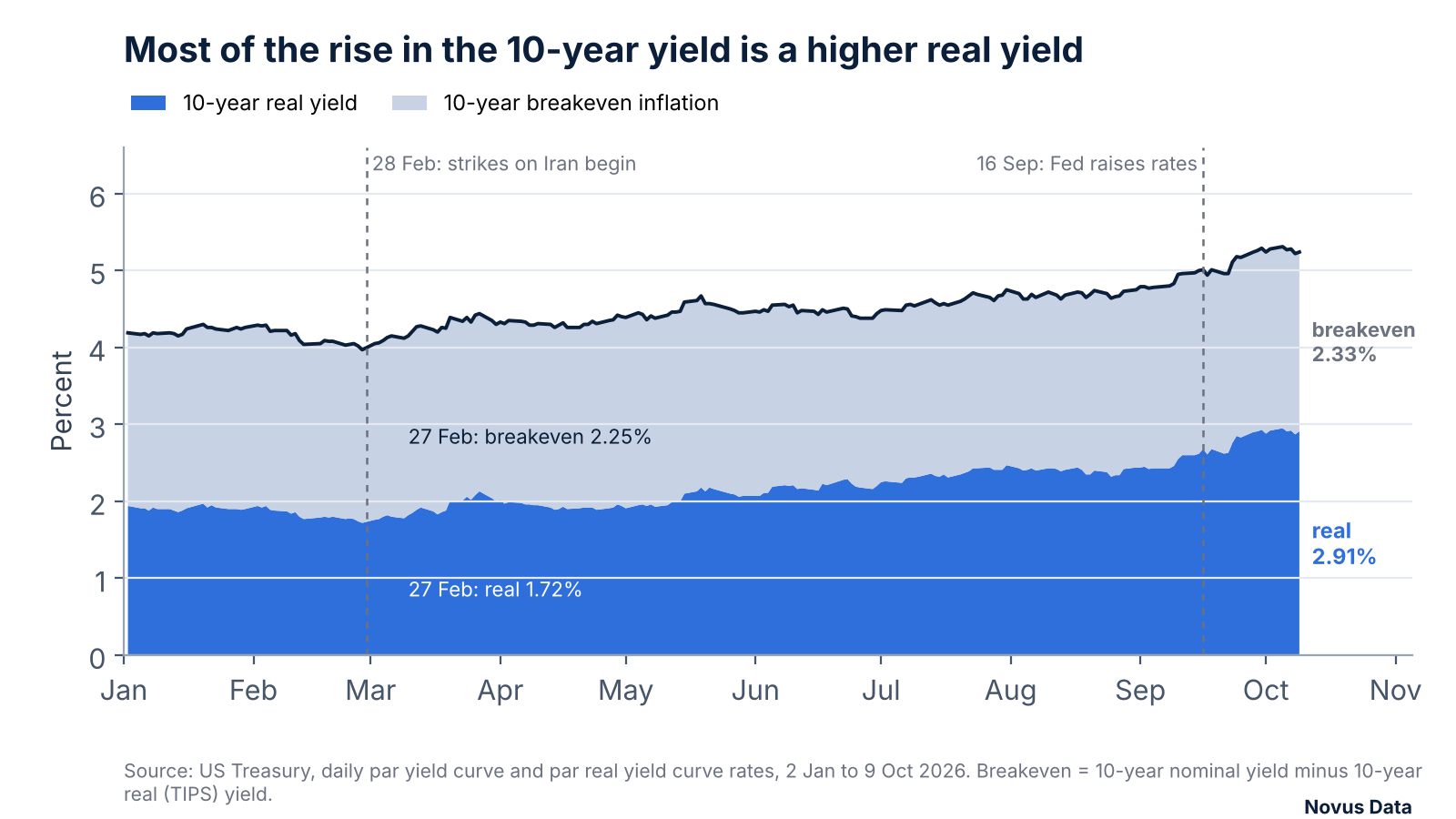
Investors do not appear to expect inflation to stay high for long. The 10-year breakeven inflation rate, the gap between the 10-year Treasury yield and the 10-year inflation-protected (TIPS) yield, was 2.33% on 9 October, little changed from 2.25% on 27 February. The 10-year real yield, the TIPS yield, rose from 1.72% to 2.91%, so 1.19 of the 1.27 percentage points added to the nominal yield came from higher real rates. Mr Warsh said the Committee aims to ensure that "inflation compensation in market prices stays low", and the breakeven is that kind of measure.
Higher real rates raise the cost of holding inventory and financing equipment, from trucks to warehouses, at a time when fuel costs are already elevated (inferred).
Who it reaches
Home buyers and builders (sector). The 30-year mortgage rate rose 1.4 percentage points between 26 February and 8 October, from 5.98% to 7.40%. Confidence: reported. Source: Freddie Mac Primary Mortgage Market Survey.
Companies financing inventory and equipment (sector). The 2-year Treasury yield, a common benchmark for short-term borrowing, rose from 3.38% on 27 February to 4.80% on 9 October. Confidence: reported for yields, inferred for borrowing costs. Source: US Treasury.
Workers (sector). Fed officials judged labour-market risks to be broadly balanced, and the unemployment rate was 4.2% in September. Confidence: reported. Sources: FOMC minutes, 7 October 2026; BLS, 2 October 2026.
What would change this view
- Core inflation. Core inflation, which excludes food and energy, was 2.6% in the 12 months to September, up from 2.4% in August, according to the September CPI report published on 14 October. A rise would suggest energy costs are broadening into other prices.
- The 27–28 October meeting. A second increase would confirm the minutes; a pause would suggest officials see the energy shock fading.
- Breakeven inflation. A sustained move above 2.5% would suggest investors doubt that inflation will return to the Fed's 2% goal. It was 2.33% on 9 October.
Sources
- FOMC statement. Federal Reserve, 16 September 2026. link
- Transcript of Chairman Warsh's press conference. Federal Reserve, 16 September 2026. link
- Minutes of the FOMC, 15–16 September 2026. Federal Reserve, 7 October 2026. link
- Summary of Economic Projections. Federal Reserve, 16 September 2026. link
- Daily Treasury par yield curve rates, 2026 (February) and October 2026. US Treasury. 2026, October
- Daily Treasury par real yield curve rates, 2026 (February) and October 2026. US Treasury. 2026, October
- Primary Mortgage Market Survey, weekly. Freddie Mac, to 8 October 2026. link
- The Employment Situation, September 2026. BLS, 2 October 2026. link
- Consumer Price Index, August 2026. BLS, 11 September 2026. link
- Consumer Price Index, September 2026. BLS, 14 October 2026. link
- Open market operations: history of federal funds rate changes. Federal Reserve. link
- Letter to the Speaker of the House on military action taken on 28 February 2026 against Iran. The White House, 2 March 2026 (House Document 119-139). link
- Israel and US launch strikes on Iran. Daily Maverick, 28 February 2026. link
Novus Data publishes analysis and commentary, not investment advice. Nothing here is a recommendation to buy or sell any security.
The Novus Data Briefing
Get the next briefing by email
Delivered by email. Free.