Article
Europe's gas storage stands near 73% as Qatari LNG stays offline
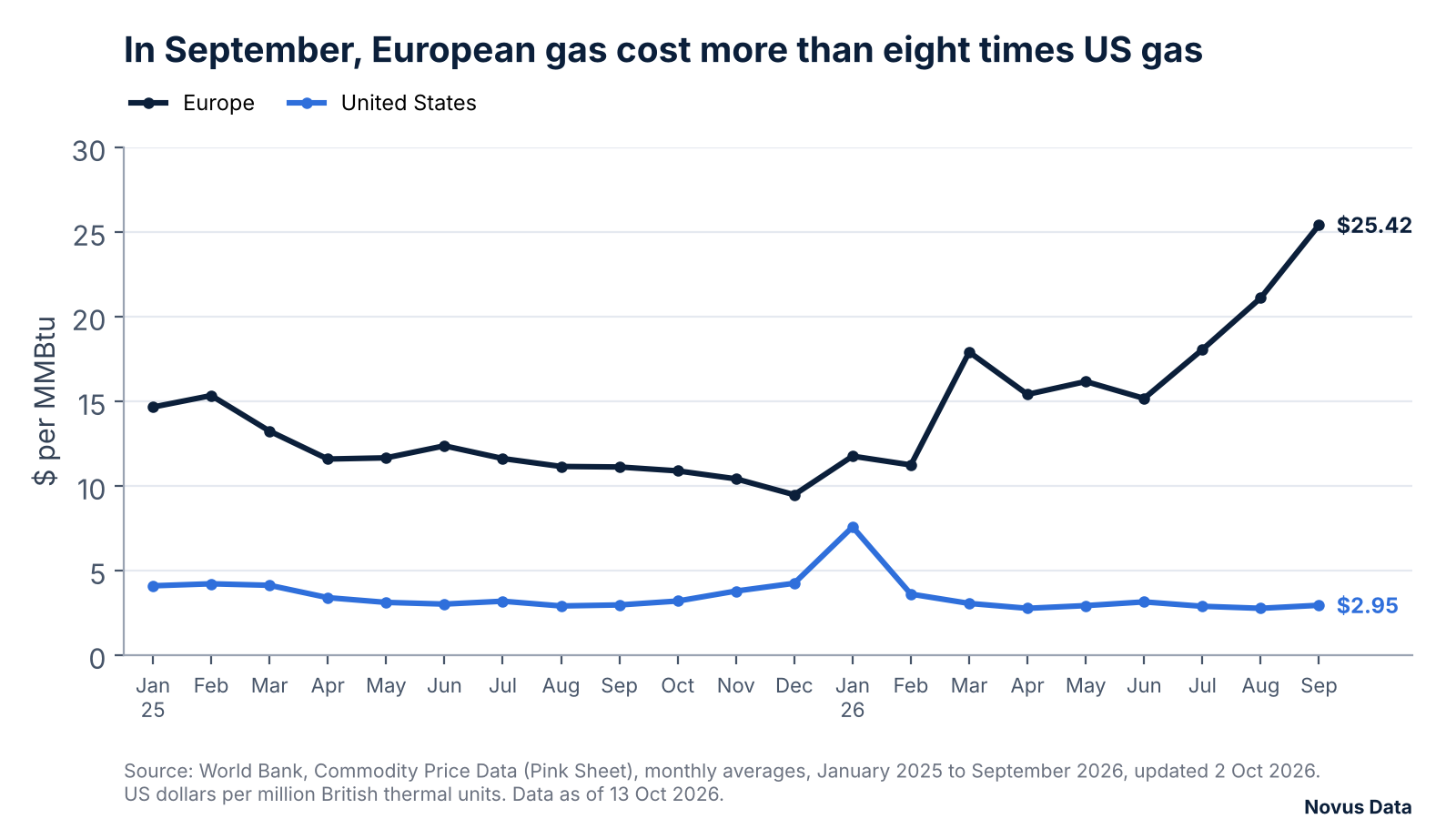
European gas cost more than eight times US gas in September 2026, a gap that is likely to steer spare LNG cargoes this winter.
What happened
European Union gas storage was 72.83% full on 6 October 2026, holding 824.7 terawatt hours, against about 81.5% on the same date in 2025, according to Gas Infrastructure Europe data compiled by ENGIE EnergyScan. The level on 26 September, 70.87%, was "the thinnest late-September cushion in the fifteen-year AGSI+ record", according to CES Intelligence. The month-ahead Dutch TTF contract, Europe's benchmark, closed at €82.52 per megawatt-hour around 18 September, the same report said.
Lost LNG supply from the Gulf, chiefly from Qatar, one of the world's largest exporters of liquefied natural gas (LNG), is the main cause (inferred). CES Intelligence links the shortfall to the effective closure of the Strait of Hormuz from early March, which it says cut Qatari and Emirati export capacity. QatarEnergy halted all LNG production at Ras Laffan on 2 March 2026 after strikes that Qatar's defence ministry said were carried out by two drones launched from Iran, and declared force majeure on LNG contracts within 48 hours, Oil & Gas Storage News reported. About 17% of Qatar's 77 million tonnes a year of capacity is expected to stay offline for up to five years while damaged facilities are repaired, AGBI reported. Undamaged plants also need tankers to pass through the Strait of Hormuz, where recorded traffic averaged under four ships a day in September, according to IMF PortWatch.
US gas has barely moved. The World Bank's European natural gas price averaged $25.42 per million British thermal units (MMBtu) in September 2026, against $11.12 a year earlier, while its US price averaged $2.95, according to its Pink Sheet updated on 2 October.
Why it matters
US gas prices stay low because the country can export only as much as its liquefaction plants can handle (inferred). Once those plants run full, extra demand abroad raises the price of cargoes rather than the price of gas at Henry Hub in Louisiana (inferred). The US Energy Information Administration expects US LNG exports to rise from 15 billion cubic feet a day in 2025 to 18 billion in 2026 and 19 billion in 2027, in its 6 October outlook.
Europe and Asia bid for the same flexible cargoes (inferred). A cold winter in north-east Asia would pull cargoes away from Europe just as storage is being drawn down (inferred).
The storage position limits how much of a supply shock Europe can absorb (inferred). CES Intelligence projects EU storage at 74% to 78% when December begins, below the relaxed 80% target, and puts its base case for TTF above €70 per megawatt-hour through the first quarter of 2027. Its scenarios range from €55 to €60 in a mild, quiet winter to above €100 if a cold snap coincides with renewed disruption in Hormuz. These are the firm's estimates, not market prices.
Who it reaches
Edison (company). The Italian utility, part of EDF, said 21 Qatari cargoes due between April and September, carrying about 2.7 billion cubic metres of gas, had been cancelled, and that it had replaced about 14 of them. Confidence: reported. Source: AGBI, mid-2026.
US LNG exporters (sector). They pay US prices near $3 per MMBtu for feed gas and deliver into markets paying several times that, with output limited by plant capacity. Confidence: inferred from World Bank and EIA data. Sources: World Bank; EIA.
Gas-intensive European industry (sector). Fertiliser, chemicals and glass makers pay prices set by the TTF benchmark, which closed above €80 in September. Confidence: inferred. Source: CES Intelligence, 4 October 2026.
What would change this view
- Daily storage data. Gas Infrastructure Europe publishes daily fill levels on its AGSI+ platform. A fall towards 60% by December would point to a tight late winter (inferred).
- Qatari exports. A resumption of LNG tanker transits through Hormuz would show first in ship-tracking data and in falling European prices.
- Asian weather. A cold early winter in Japan, South Korea or China would increase competition for cargoes.
Sources
- Europe gas storage levels: weekly fullness rate tracker and analysis. ENGIE EnergyScan, data for 6 October 2026, citing GIE AGSI+. link
- European gas storage 2026: daily signal. CES Intelligence, 4 October 2026, citing GIE AGSI+. link
- QatarEnergy Ras Laffan: LNG shutdown, force majeure and restart. Oil & Gas Storage News, 9 April 2026. link
- Force majeure on QatarEnergy LNG extends to fourth month. AGBI, mid-2026. link
- Commodity Price Data (The Pink Sheet), monthly prices. World Bank, updated 2 October 2026. link
- Short-Term Energy Outlook. EIA, 6 October 2026. link
- Daily chokepoint transit calls, Strait of Hormuz. IMF PortWatch. link
Novus Data publishes analysis and commentary, not investment advice. Nothing here is a recommendation to buy or sell any security.
The Novus Data Briefing
Get the next briefing by email
Delivered by email. Free.