Article
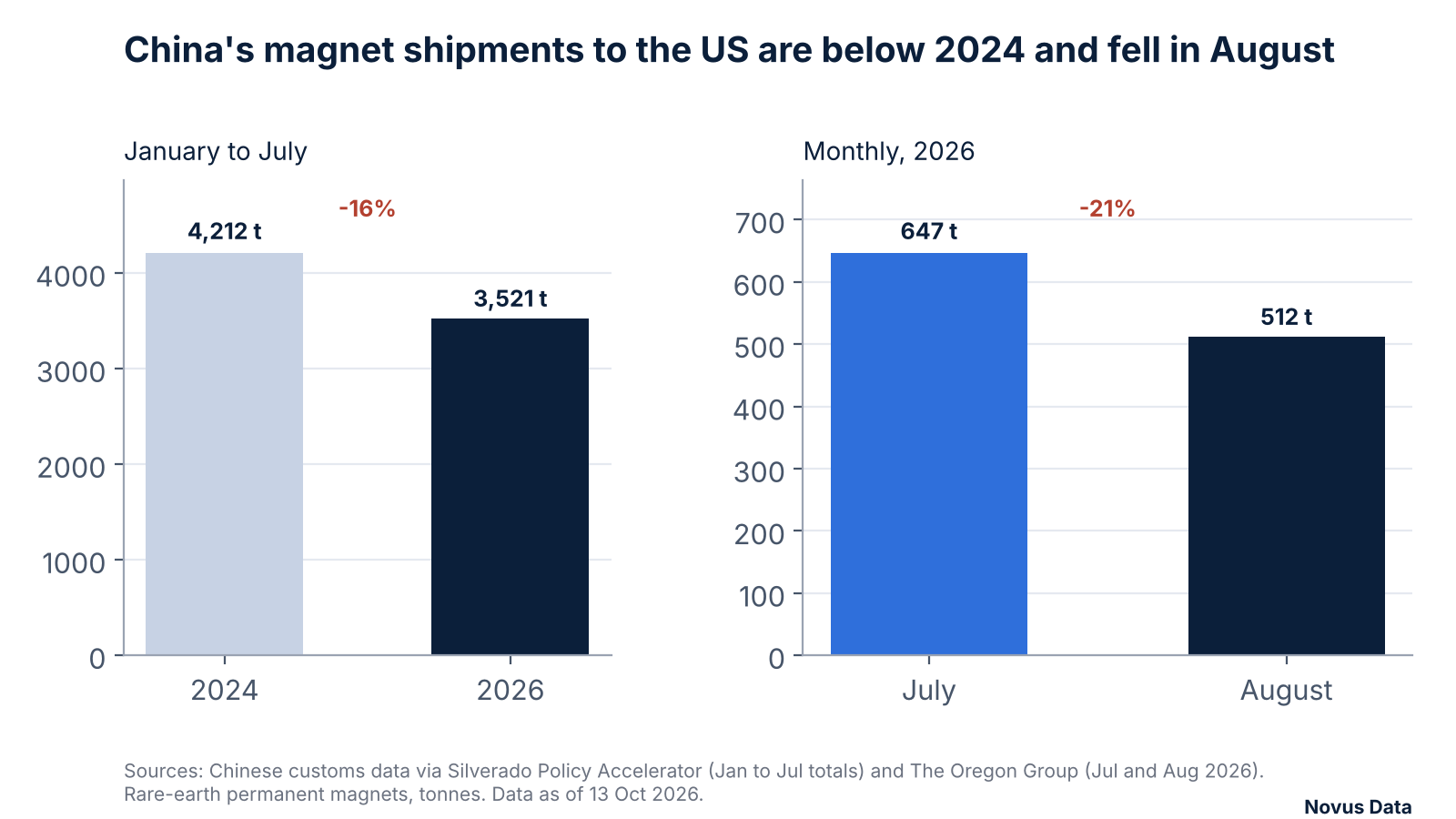
China's rare-earth magnet shipments to the US fell 21% in August
The truce suspended China's broadest export controls, but licensing rules from April 2025 still cover seven heavy rare earths and magnets made from them.
What happened
China exported 512 tonnes of rare-earth magnets to the United States in August 2026, down 21% from 647 tonnes in July and 13% lower than a year earlier, according to Chinese customs data reported by The Oregon Group. In the first seven months of the year, China shipped 3,521 tonnes of magnets to the US, 16% less than the 4,212 tonnes shipped in the same period of 2024, according to the Silverado Policy Accelerator. China's global magnet exports in July, at 5,375 tonnes, were slightly above the 5,278 tonnes of July 2024. Shipments to other buyers grew: in January to July, exports to the EU were 17% higher than in the same months of 2024 and exports to India 39% higher, The Oregon Group reported.
Two layers of Chinese control apply. Export controls announced on 9 October 2025, which added five elements and rules reaching foreign-made products, are suspended under the US-China truce, according to China Briefing. Controls announced on 4 April 2025, covering seven heavy rare earths (samarium, gadolinium, terbium, dysprosium, lutetium, scandium and yttrium) and magnets containing them, remain in force and require case-by-case licences, Tech Times reported. Since December 2025, three Chinese magnet makers, JL MAG Rare-Earth, Beijing Zhong Ke San Huan and Yunsheng, have held general licences allowing year-long, multi-shipment permits for pre-cleared customers, excluding defence and aerospace users, the same report said.
Why it matters
Rare-earth magnets go into electric motors, wind turbines, defence systems and industrial robots, and China produces most of them. A licence system turns supply into an administrative decision: shipments depend on approvals that can be sped up or slowed without any formal change in policy (inferred). The German Marshall Fund cited a Financial Times report that Beijing was meeting only two-thirds of its commitments on rare earths and other critical minerals under the truce. US-bound shipments fell while shipments to other buyers rose, which points to licensing rather than demand as the constraint on the US (inferred).
Some elements are tighter than the magnet totals suggest. In July, China's dysprosium exports returned to around historical levels, but none went to the US; all 11 tonnes exported that month went to South Korea, according to Silverado. Analysis by CSIS cited by Tech Times found that yttrium exports to the US fell from more than 333 tonnes in the eight months before April 2025 to 17 tonnes in the eight months after.
Who it reaches
US aerospace and defence suppliers (sector). Defence and aerospace users are excluded from China's general licences, and aerospace manufacturers have reported shortages and rationing of yttrium, Tech Times reported. Confidence: reported. Source: Tech Times, 26 May 2026.
Electric motor and vehicle makers (sector). They depend on rare-earth permanent magnets, mainly neodymium-iron-boron, and US-bound shipments of rare-earth magnets from China were 16% lower in January to July 2026 than in the same months of 2024. Confidence: reported for volumes, inferred for exposure. Source: Silverado Policy Accelerator.
MP Materials (company). The US rare-earth producer received a $400 million commitment from the Department of Defense and signed a $500 million supply agreement with Apple in July 2025, and produced a record 2,599 tonnes of neodymium-praseodymium oxide in 2025, according to Tech Times. Limits on Chinese supply raise demand for non-Chinese sources. Confidence: reported for the agreements, inferred for the demand effect. Source: Tech Times, 26 May 2026.
What would change this view
- September customs data. Chinese trade data by destination for September will show whether August was a one-month dip.
- More general licences. New general licences for civilian users would ease supply to US manufacturers.
- 10 January 2027. US Treasury Secretary Scott Bessent said in September that the truce would run to that date, Supply Chain Dive reported. If it lapses, the suspended October 2025 controls could return (inferred).
Sources
- China's rare-earth magnet exports to US fall 21% before Trump-Xi summit. The Oregon Group, 21 September 2026. link
- China's global exports of rare earths: August 2026 update. Silverado Policy Accelerator, 31 August 2026. link
- China rare earth export controls: April curbs still bite after Beijing summit. Tech Times, 26 May 2026. link
- A Trump-Xi summit scorecard. German Marshall Fund, 28 September 2026. link
- Trump-Xi meeting: outcomes and implications. China Briefing, November 2025. link
Novus Data publishes analysis and commentary, not investment advice. Nothing here is a recommendation to buy or sell any security.
The Novus Data Briefing
Get the next briefing by email
Delivered by email. Free.