Article
Urea's war spike has faded as China lets exports resume
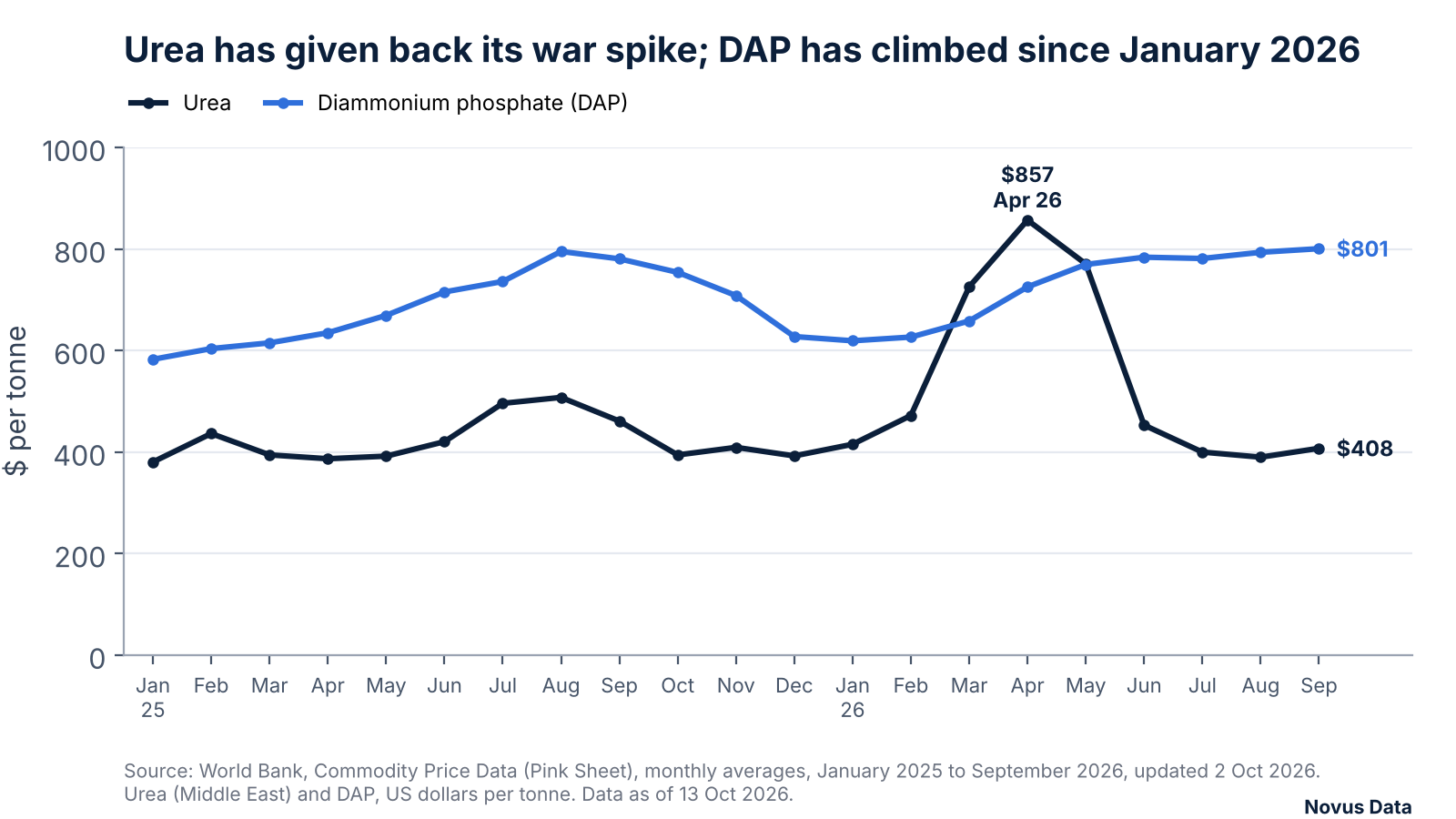
The nitrogen fertiliser peaked at $857 a tonne in April 2026 and was $408 in September, below a year earlier. The price of diammonium phosphate has kept climbing.
What happened
The World Bank's benchmark price for Middle East urea averaged $407.50 a tonne in September 2026, according to its Pink Sheet updated on 2 October. That was below the $461.10 recorded in September 2025 and less than half the April peak of $856.90. Urea rose sharply after the United States and Israel launched strikes on Iran on 28 February, Reuters reported, from $472 in February to $725.60 in March.
Prices have come in well below the World Bank's April forecast (inferred). In its April Commodity Markets Outlook, the World Bank forecast an average urea price of about $675 a tonne in 2026, and warned that a prolonged closure of the Strait of Hormuz could significantly disrupt global fertiliser trade. The average for January to September was $543, according to Novus Data calculations from the Pink Sheet.
Fertilizer Daily attributed the recent easing mainly to China, in a report on 9 September. Beijing relaxed its urea export restrictions and raised its export allowance for 2026 to roughly 5 million to 5.5 million tonnes; Chinese shipments rose to about 403,000 tonnes in July from about 7,000 tonnes in June. Seasonal demand also eased as northern hemisphere planting largely concluded, and an Indian import tender bought 1.78 million tonnes at prices below $400. Brazil, a large importer, postponed purchases, the same report said. Urea fell to $453.10 in June, its first month below $500 since the war began, and has stayed between $390 and $410 since July.
Why it matters
Urea is made mainly from natural gas, so European gas prices largely set European producers' costs (inferred). Fertilizer Daily estimated that an efficient European urea plant needs about $605 a tonne to break even, ex-works, with Dutch gas above €66.50 per megawatt-hour in early September. The World Bank's European gas price averaged $25.42 per million British thermal units in September, up from $21.11 in August and more than double the $11.12 of a year earlier. With urea near $408, many European producers would be pricing below that estimated cost (inferred). If they cut output, Europe would rely more on imports while Gulf supply remains disrupted (inferred).
Phosphate is a separate story. The World Bank's price for diammonium phosphate (DAP) was $800.60 a tonne in September, up from $780.60 a year earlier and the highest monthly level since May 2022. Potassium chloride, at $367.50, was little changed from $352.50. Unlike urea, DAP barely moved when the war began: it rose from $626.50 in February to $658.30 in March, and has risen in most months since. Farmers' total fertiliser bills therefore depend heavily on their nutrient mix (inferred).
Who it reaches
European nitrogen fertiliser producers (sector). Their estimated break-even of about $605 a tonne ex-works is well above the World Bank's September Middle East price of $407.50, although the two prices are not directly comparable (inferred). Confidence: estimated, based on Fertilizer Daily's cost estimate. Source: Fertilizer Daily, 9 September 2026.
Farmers buying phosphate (sector). DAP prices are higher than a year ago while urea is lower. Confidence: reported for prices. Source: World Bank Pink Sheet.
Chinese urea exporters (sector). Higher export allowances let Chinese producers ship into a market short of Gulf supply; July shipments were about 403,000 tonnes. Confidence: reported for allowances and shipments, inferred for the link to Gulf supply. Source: Fertilizer Daily, 9 September 2026.
Fertiliser importers in India (sector). An import tender secured 1.78 million tonnes of urea at prices below $400 a tonne, well under the spring peak. Confidence: reported. Source: Fertilizer Daily, 9 September 2026.
What would change this view
- China's export policy. A tightening of Chinese export allowances would remove the main source of relief.
- Gulf shipping. A return to normal traffic through Hormuz would bring back Gulf urea; further escalation would cut it again.
- The World Bank's October outlook. Its next Commodity Markets Outlook, due in October 2026, will carry a new urea forecast.
- Spring 2027 buying. Northern hemisphere demand for the 2027 season usually builds over the winter.
Sources
- Commodity Price Data (The Pink Sheet), monthly prices. World Bank, updated 2 October 2026. link
- Commodity Markets Outlook, April 2026. World Bank, 28 April 2026. link
- Urea eases to $443/t as Hormuz negotiations and China's export surge quiet global supply fears. Fertilizer Daily, 9 September 2026. link
Correction, 14 October 2026: an earlier version said the World Bank's April outlook described the Strait of Hormuz as carrying nearly a third of global seaborne fertiliser trade, about 16 million tonnes a year. That figure came from a news report on the outlook, not from the World Bank report, and has been removed. The outlook's urea forecast is unchanged and is now linked directly.
Novus Data publishes analysis and commentary, not investment advice. Nothing here is a recommendation to buy or sell any security.
The Novus Data Briefing
Get the next briefing by email
Delivered by email. Free.