Article
Panama Canal restores some capacity after a rainfall squeeze
The canal offers 33 daily booking slots from 15 October 2026 and a deeper Neopanamax draft, but a water deficit remains and NOAA expects a strong El Niño.
What happened
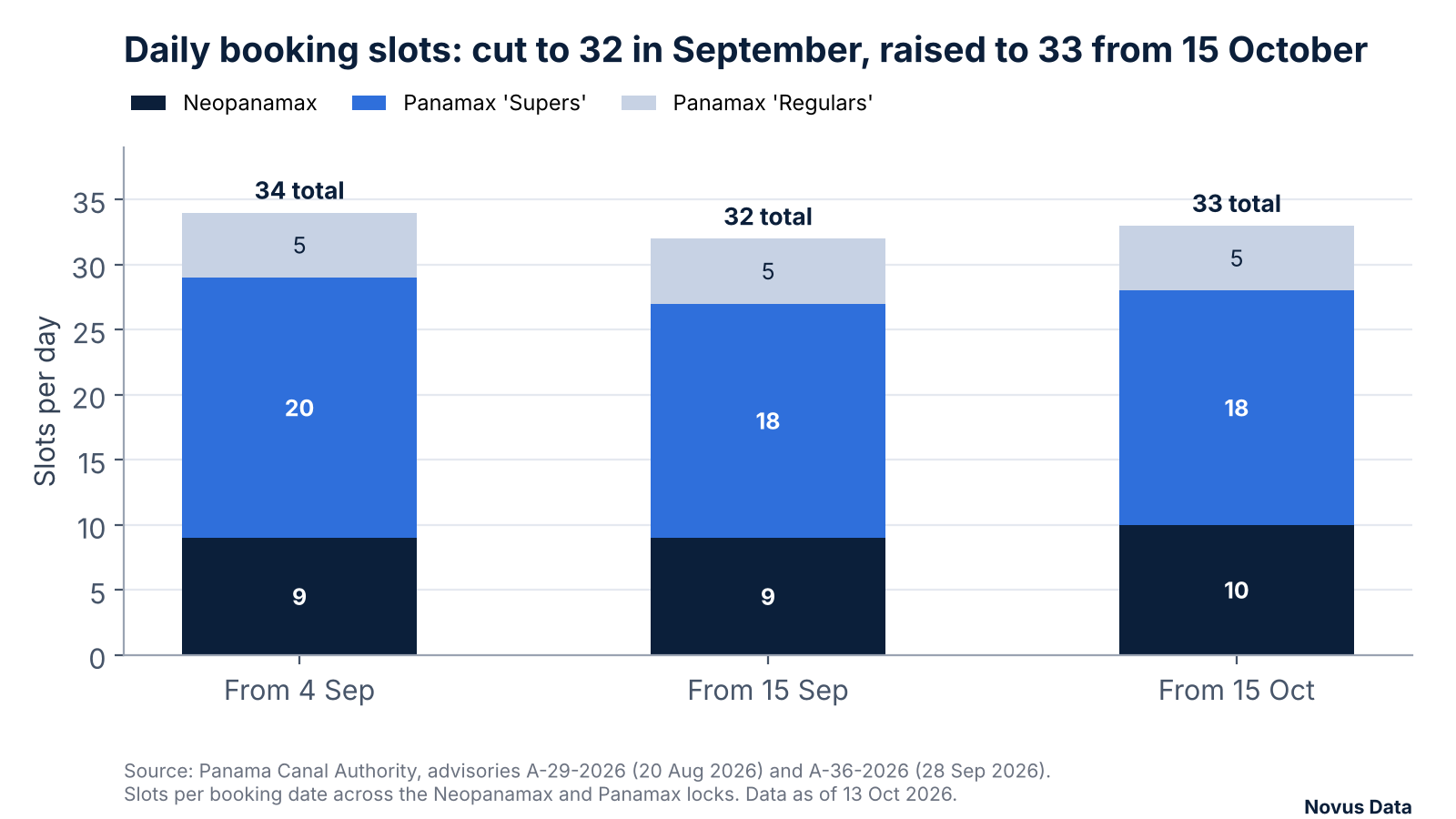
The Panama Canal Authority (ACP) said on 28 September 2026 that it would raise the maximum draft at its Neopanamax locks to 14.94 metres (49.0 feet) with immediate effect, and add a tenth daily Neopanamax booking slot for booking dates from 15 October, according to Advisory A-36-2026. Total daily slots across both sets of locks rise to 33: 10 Neopanamax, 18 for larger Panamax-lock ships, which the ACP calls "Supers", and 5 for smaller "Regulars".
The change partly reverses measures announced on 20 August. That day the ACP said rainfall in the hydrological year since May was 34% below the historical average and watershed inflows 44% below their historical average, and that forecasts indicated "the anticipated severity of the 2026-2027 El Niño event could further reduce precipitation and runoff", according to Advisory A-29-2026. It set 34 daily slots for booking dates from 4 September and 32 from 15 September, and postponed planned cuts in the Neopanamax maximum draft, to 14.63 metres until 2 September and to 14.48 metres until 1 October. In Advisory A-28-2026, issued the same day, it suspended its Last-Minute booking service and limited each customer to one slot per day in booking competitions.
In announcing the increase, the ACP cited rainfall recorded in September, which its news release called close to average, water-saving measures at the locks and the current and projected level of Gatún Lake, which supplies the locks. It gave no lake level and said a water deficit continues in the watershed. For the Neopanamax locks, for booking dates from 15 October, A-36-2026 also lifted the one-slot-per-customer limit and allowed the Last-Minute service to be offered again when a slot becomes available, at the ACP's discretion.
Why it matters
The canal rations capacity in two ways, and they reach shippers differently. A slot limit caps how many ships can book a transit each day. A draft limit caps how deep a ship may sit in the water, and so how much cargo it can carry. A vessel may pass on schedule with fewer containers or tonnes aboard, which raises the cost of each unit moved (inferred).
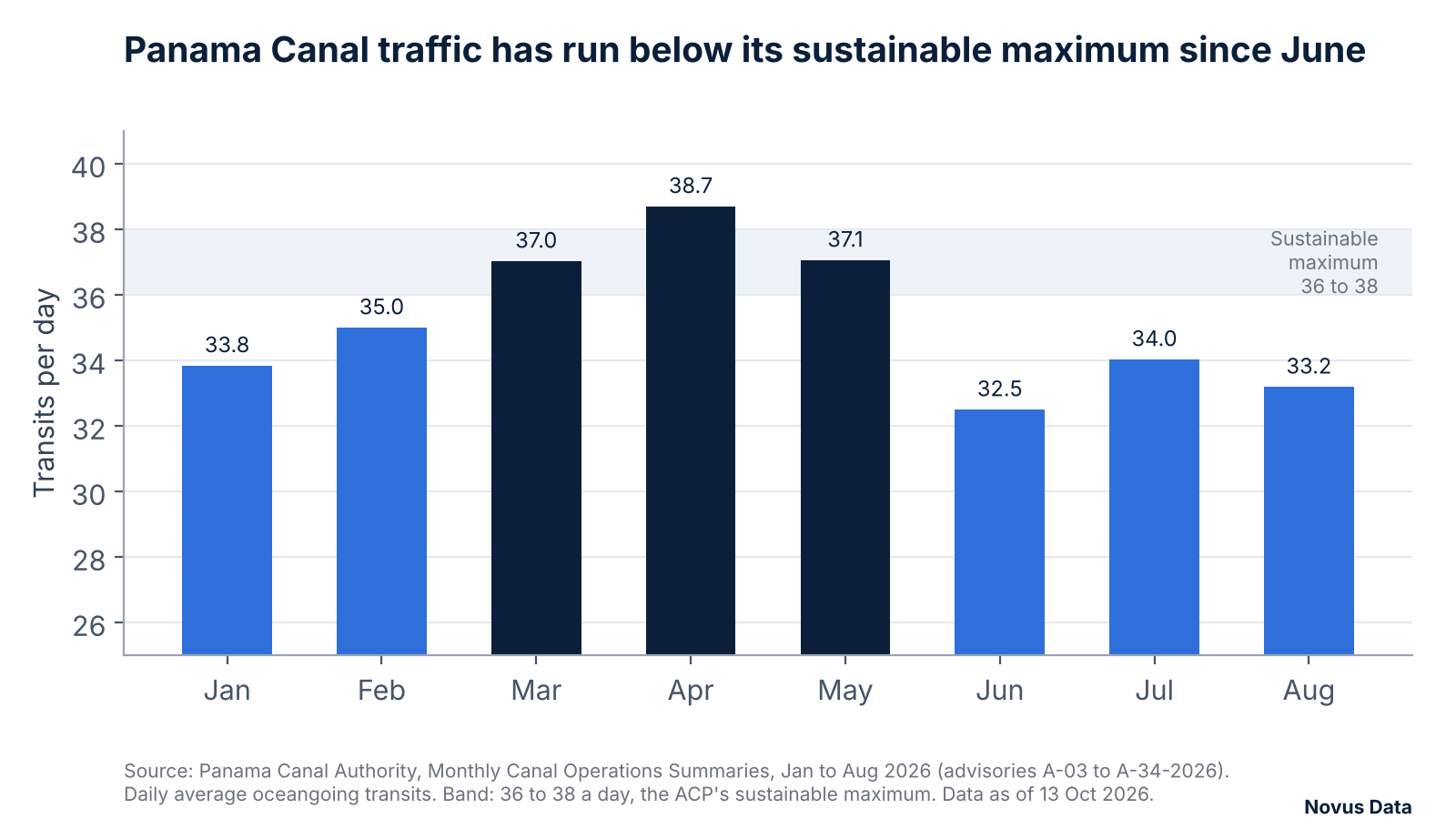
Traffic was already below the canal's normal pace before the August measures took effect. The canal averaged 33.19 oceangoing transits a day in August, against 38.70 in April, according to the ACP's monthly summaries for August and April. The August summary puts the sustainable maximum at about 36 to 38 a day. Ships spent an average of 34.90 hours in canal waters in August.
The ACP said in A-36-2026 that while the water deficit continues, the booking system is "the only mechanism to guarantee a transit date", and that ships without a reservation may face indefinite delays. When slots are scarce, the cost tends to show up in auction prices and waiting time rather than in published tolls, and it reaches cargo owners later through surcharges or slower delivery (inferred).
Who it reaches
Container shipping (sector). A-36-2026 sets a minimum of six full-container slots per booking date, or 42 a week, the largest allocation of any segment, split evenly across three ship-size bands. In August, A-28-2026 had given the largest container ships priority at the Neopanamax locks. The deeper draft lets the largest ships load closer to capacity. Confidence: reported for the allocation, inferred for the loading effect. Source: A-36-2026; A-28-2026.
LPG shipping (sector). Liquefied petroleum gas carriers receive a minimum of three slots per booking date, or 21 a week. Confidence: reported. Source: A-36-2026.
LNG shipping (sector). Liquefied natural gas carriers receive a minimum of four slots a week. Confidence: reported. Source: A-36-2026.
Users of the older Panamax locks (sector). The October increase applies to the Neopanamax locks only. Panamax-lock slots stay at 23 a day, against 25 for booking dates from 4 to 14 September. Confidence: inferred from A-29-2026 and A-36-2026 taken together.
What would change this view
- A new ACP advisory. A cut in slots or draft would show the improvement did not hold; a further increase would show the lake recovering. Advisories are published at pancanal.com.
- El Niño. The US Climate Prediction Center said on 8 October 2026 that a strong-to-very strong El Niño is likely through January to March 2027, with a chance above 83%, according to its ENSO discussion. The ACP flagged concern in August about water for the 2027 dry season, which runs from January to April. NOAA's next update is due on 12 November.
- September traffic. The ACP's monthly summary for September will show whether daily transits moved back towards 36.
Sources
- Advisory A-36-2026: Increase in the Number of Neopanamax Booking Slots, Draft Adjustment and Transit Reservation System. Panama Canal Authority, 28 September 2026. link
- Panama Canal announces increase in draft and daily transit. Panama Canal Authority, 28 September 2026. link
- Advisory A-29-2026: Additional Measures to Address Reduced Precipitation in the Canal Watershed. Panama Canal Authority, 20 August 2026. link
- Advisory A-28-2026: Transit Reservation (Booking) System Rule Modifications. Panama Canal Authority, 20 August 2026. link
- Monthly Canal Operations Summaries, January to August 2026 (A-03, A-04, A-09, A-14, A-19, A-23, A-26 and A-34-2026). Panama Canal Authority. August, July, April
- ENSO Diagnostic Discussion. NOAA Climate Prediction Center, 8 October 2026. link
Novus Data publishes analysis and commentary, not investment advice. Nothing here is a recommendation to buy or sell any security.
The Novus Data Briefing
Get the next briefing by email
Delivered by email. Free.