Article
Forced-labour tariffs of 10% to 12.5% now cover 60 economies
New Section 301 duties took effect on 24 July 2026, as a temporary global surcharge expired. Each country's rate depends on its rules on imports made with forced labour.
What happened
The Office of the US Trade Representative (USTR) imposed additional duties on goods from 60 economies entered from 12:01 a.m. Eastern time on 24 July 2026, according to a notice published in the Federal Register on 28 July. USTR found that 54 economies had failed both to impose and to enforce a ban on importing goods made with forced labour, and that six (Canada, Ecuador, the European Union, Indonesia, Mexico and Pakistan) had failed to enforce the ban they have.
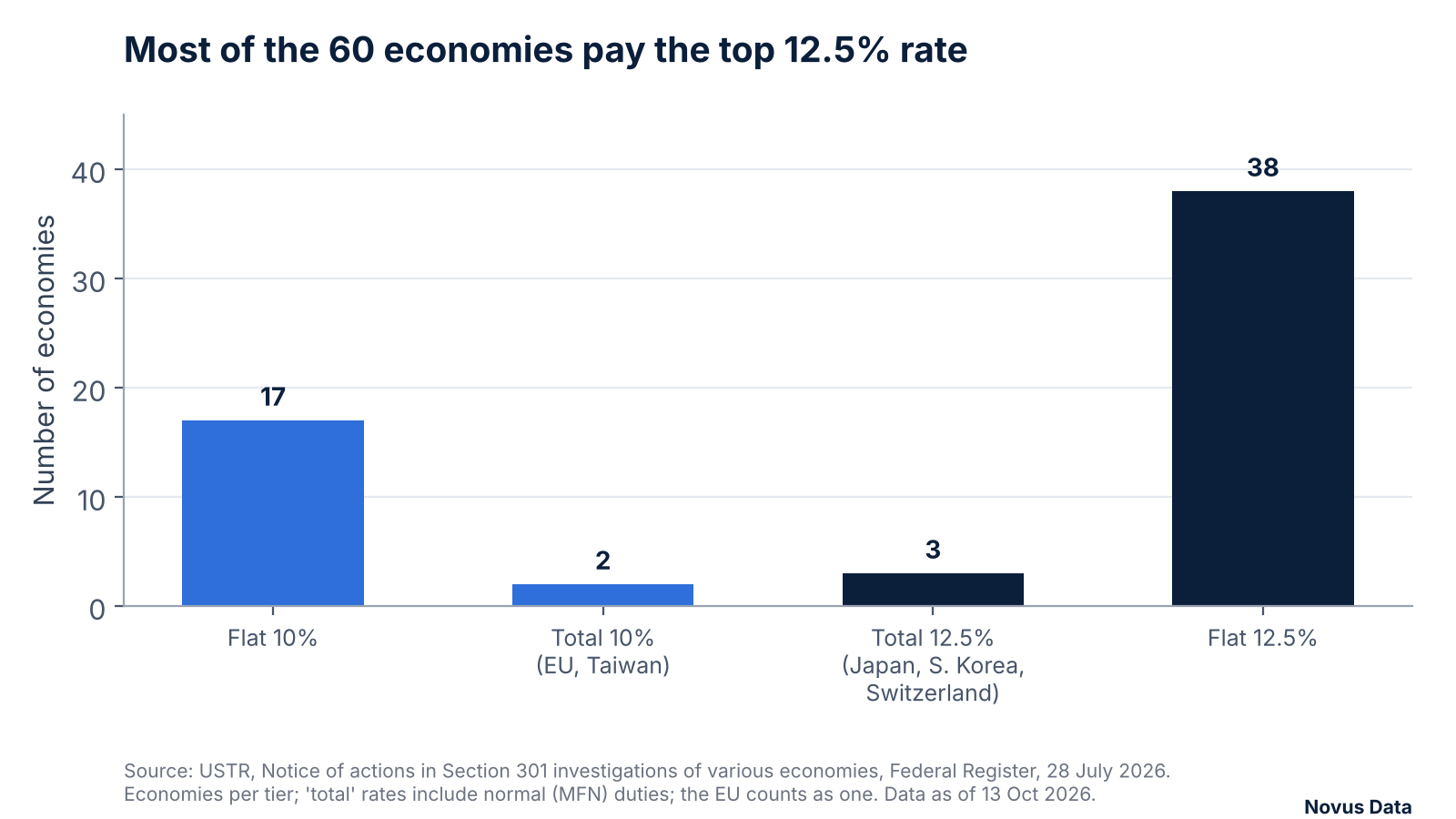
The rate depends on the finding. Seventeen economies, including Canada, Mexico, India and the United Kingdom, pay a flat 10%. For the EU and Taiwan, the duty brings the total, including normal duties, to 10%; for Japan, South Korea and Switzerland it brings the total to 12.5%. In both cases the Section 301 duty is zero where the normal duty is already at or above that level. All other investigated economies, including China and Vietnam, pay a flat 12.5%. USTR had proposed the actions on 5 June.
Exemptions are significant. The notice exempts products already subject to Section 232 tariffs, such as steel and aluminium, along with products listed in its annexes, according to the notice and Holland & Knight. Goods that qualify for duty-free treatment under the US-Mexico-Canada Agreement are also exempt, according to BBVA Research and Holland & Knight.
Why it matters
This is the third legal basis for broad US tariffs in 18 months. Tariffs imposed in 2025 under the International Emergency Economic Powers Act ended after the Supreme Court ruled on 20 February 2026 that the law does not authorise tariffs. A 10% surcharge under Section 122 of the Trade Act followed, under Proclamation 11012; the law limits such a surcharge to 150 days, and it expired as the new duties took effect. Section 301 has no fixed expiry of that kind, though actions are reviewed every four years, and it has been used for tariffs on Chinese goods since 2018, according to Dorsey & Whitney.
USTR says each rate follows its finding on that economy's forced-labour rules. Honduras was placed in the 10% tier after adopting a ban following the June proposal, according to the notice, which suggests a country that adopts and enforces a ban can argue for a lower rate (inferred). Importers suing over the duties argue they are "the third unlawful version of one global tariff regime", and one complaint alleges USTR "determined the tariff rates first", FreightWaves reported. For importers, the tariff on a given supplier country can therefore change through foreign legislation as well as US decisions (inferred). Whether the largest Asian suppliers in the 12.5% tier, such as China and Vietnam, adopt bans that move them to a lower rate is the main open question (inferred).
The process drew heavy participation: more than 1,600 written comments and more than 100 witnesses at a three-day hearing from 7 to 9 July, according to the notice.
Who it reaches
Importers from Vietnam and China (sector). These economies are in the 12.5% tier, the highest. Confidence: reported. Source: USTR, 28 July 2026.
Apparel importers using Bangladesh, Cambodia, Indonesia and Malaysia (sector). USTR plans tariff-rate quotas with an initial three-year duration for these countries, linked to their use of US cotton and textile inputs. Confidence: reported. Source: USTR, 28 July 2026.
US cotton exporters (sector). The quota design rewards foreign mills for buying US inputs. Confidence: inferred from the stated purpose of the quotas. Source: USTR, 28 July 2026.
Manufacturers in Mexico and Canada (sector). Their USMCA-qualifying goods are exempt; goods that do not qualify pay 10%. Confidence: reported. Sources: BBVA Research; Holland & Knight.
What would change this view
- New forced-labour bans. Each adoption that USTR accepts could move a country to a lower tier (inferred).
- The textile quota notice. A separate notice will establish the quotas and set their effective date.
- Legal challenges. Importers including Learning Resources sued at the Court of International Trade over the Section 301 duties on the day they took effect, Holland & Knight and FreightWaves reported. A ruling against the duties would change costs for importers.
Sources
- Notice of actions in Section 301 investigations of acts, policies and practices of various economies. USTR, Federal Register, 28 July 2026. link
- And the (tariff) beat goes on. Holland & Knight, 30 July 2026. link
- Mexico: favourable position on new US tariffs under Section 301 for forced labour. BBVA Research, 24 July 2026. link
- Learning Resources, Inc. v. Trump. Supreme Court, 20 February 2026. link
- Proclamation 11012. Federal Register, 25 February 2026. link
- Forced labor tariffs draw lawsuits. FreightWaves, 28 July 2026. link
- US third set of tariffs on products from China. Dorsey & Whitney, September 2018. link
Novus Data publishes analysis and commentary, not investment advice. Nothing here is a recommendation to buy or sell any security.
The Novus Data Briefing
Get the next briefing by email
Delivered by email. Free.